



Many writers ask us : How can Indian writers publish a book in UK/USA? So, today we would like to address that question with the help of two HWR Alums.
Dear poet/writer, we’d love to know you better.
What are you writing?
In prose, you prefer…
To stay informed about articles related to poetry writing,
would you like to get emails from us?
We don’t spam and you can unsubscribe any time.
In prose, you prefer…
To stay informed about articles related to fiction writing,
would you like to get emails from us?
And we’re happy to throw in two free courses, too
We don’t spam and you can unsubscribe any time.
To stay informed about articles related to prose and poetry writing,
would you like to get emails from us?
And we’re happy to throw in two free courses, too
We don’t spam and you can unsubscribe any time.
To stay informed about articles related to non-fiction writing,
would you like to get emails from us?
And we’re happy to throw in two free courses, too
We don’t spam and you can unsubscribe any time.
First up, we have Kamalini Natesan – a language teacher, writer and poet who has authored two books – Naked Beneath the Midnight Sun (2019, Olympia UK) and, The Fire Ant’s Sting: Desire Diaries, an anthology of twelve tales (2023, Om Books International). Here’s her experience in her own words.
The Piece after hers is about Publishing in the US.
{If you are new to the industry and would like to know more about getting published in India, check out this article: Get Published in India: This Nine Point Checklist will Help}
Kamalini Natesan’s experience of publishing a book in UK:
My experience of publishing a book in the UK with Olympia International was an exceedingly positive one.
When I completed Naked Beneath the Midnight Sun (my debut novel) manuscript, back in 2018, I didn’t twiddle my thumbs; I sent it out (according to all subscription guidelines) to various Indian publishers. I was rejected by most, politely I hasten to add, and was told to continue to search for those interested in memoir type writing. I was unaware that I’d written a memoir, and it made me smile. Suchareeta’s story was more of a coming-of-age narrative, but whatever.







Within a span of a month, Readomania accepted it and asked me to work on the raw manuscript. Ultimately, after having had me co-sign an agreement they decided to not go through with it. I was devastated, and in that disappointment and anger, I sent out my manuscript to many foreign publishers. Some responded, some didn’t. Olympia’s response was positive and landed in my inbox after approximately six weeks. They wanted to read more. As one might imagine, I was overjoyed about getting the chance to publish a book in UK, but just that little skeptical – would they like it all? Would they eventually decide to reject me too? Is my story strong enough? How will the process affect my narrative?
Eventually, as they say, my book got treated with respect and a round of edits, which was the most delicious part. The suggestions and changes that followed enhanced the story and insofar as debuts go, I was more than delighted by Olympia’s team’s dedication to my book, its cover and its publicity. One side effect of publishing a book in UK is that I lost out on many Indian readers because of the pricing in India (started with Rs 1200 and finally coming down to Rs 900- still very high).
The quality of production and the print was stellar. I can’t complain.
When I began writing my Norwegian saga I had no plan in mind. I was a raw, unpublished author- but I had already published a fair number of short stories, and continued honing my skills. Writing a novel was no piece of cake- like making a movie, or writing a screenplay- one needs to have continuity from one scene to the next; there has to be some takeaway, the character needs to develop and its arc needs to undergo some strong change, otherwise the story falls flat and you lose your reader to boredom. As a writer, one needs to revisit one’s story repeatedly- sharpening the edges, rounding off those areas which fall flat and bring nothing (or little) to the reader’s mind. I’m learning as I now write my third book. It’s an exciting phase, but Olympia remains etched in me, as the one publisher who helped me emerge as a novelist, and handheld through a process which could’ve been tedious and exhausting.
I’m forever grateful to them.
{If you are a bit lost on all the traditional publishing houses, check out or list of 50 Traditional Publishing Houses in India}
Next up we have Arva Bhavnagarwala. She is pediatrician by day, writer by night and struggling mom to two boys 24×7. A voracious reader and a dreamer are the qualities that describes her the best. Her book ‘A Little Bit of Love’ will be published in USA soon. Here’s her experience with Shaherazad Shelves in her own words.
Arva Bhavnagarwala’s experience of publishing a book in USA:
When my book deal was announced, many people asked me ‘How did you do this? Can you tell us?’
Yes, I will. But it is good to keep this one thing in mind: Traditional publishing is often a very slow process, taking anything between 1 to 3 years from submitting a polished manuscript to actually holding the book in your hands. The road is laid in thorns, with a few petals here and there. If you believe in yourself and your book, and are in this for the long haul, then why not? Go for it!
In this post, I’ll explain the steps that can help get you an agent or a book deal abroad for Fiction manuscripts.
- Making sure the book falls in the correct word count as per the genre
- Polishing the Manuscript and Beta readers
- Comparable titles
- Submission Package
- Where to find Agents and Publishers?
- Patience and Perseverance
- Why did I choose to be published with an international publisher?
1. Correct Word Count:
Understanding this as per the genre of the book is extremely important. An ideal word count is 65k to 95k. Higher side for fantasy. Lower for Young Adult. Anything in between is the safest. I’ve mentioned this first because if your book is too low in word count (the first book I queried was only 50k words until a kind agent pointed it out to me) or too high, there won’t be many takers for it.
2. Polishing your manuscript and Beta Readers:
You’ve finished your first draft! Congratulations. Now what do you do? Send it to your friends and family, who will praise it like anything and boost your ego.
No.
You take a break from it. Go back and revise. Then do it again, until you’re sure this is the best version you can do by yourself.
Now, you send it to your trusted writer friends for their opinion. They are your beta readers, and they’ll point out plot holes, or other inconsistencies that you might have missed. If you send out the first draft to them, they are alpha readers, and they’ll mostly point out things you already know you would be correcting in the subsequent round of revising. Now that would be a waste of time and resources. Wouldn’t it?
Good beta readers also help in developmental and structural edits. It is great to have a beta reader who is well-versed in the genre you write in.
After this is the editing. Line edits and proofreading. You can do this yourself or if you can afford it, hire a professional. I did it by myself; read craft books on pacing, how to balance show and tell, and writing in a deep POV to involve the reader more in the book.
Once all these steps are done, and you’re certain this is the best version of your book, your manuscript is ready.
3. Comparable titles:
Before you move on to the submission package, it is crucial to know where your book lies on the shelf in a bookstore. Age category, Genre, and any particular theme. My debut A LITTLE BIT OF LOVE is an Adult, Contemporary Romance, featuring Muslim protagonists and themes of complicated families and medical conditions. The comp titles I used were Ayesha At Last, by Uzma Jalaluddin (an Adult Romance that features Muslim protagonists and complicated families) and Act Your Age, Eve Brown by Talia Hibbert (an Adult Romance featuring the tropes of grump/sunshine and some medical conditions).
Knowing your comp titles shows how well-read you are in your genre. These titles need to be published in the last five years or so. Use the very popular ones with caution. The query letter should include at least 2 to 3 titles. Movies and OTT shows can also be one of them.
{Wondering if you should just self-publish your book? Here a list of 48 Self-Publishing companies in India. And how to choose the right one.}
4. Submission Package:
Once you have the above four, it’s time to prepare this package. It usually has a query letter, a synopsis, and the first few pages of the manuscript.
The query letter is like the summary on the back jacket of the book. It should have all the metadata (title, the age category, genre, word count, and comparable titles), the main characters clearly outlining their goals, motivation and conflict, along with a short author bio (mention writing credentials if any). All this should ideally be under 350 words.
This was how I started my query letter:
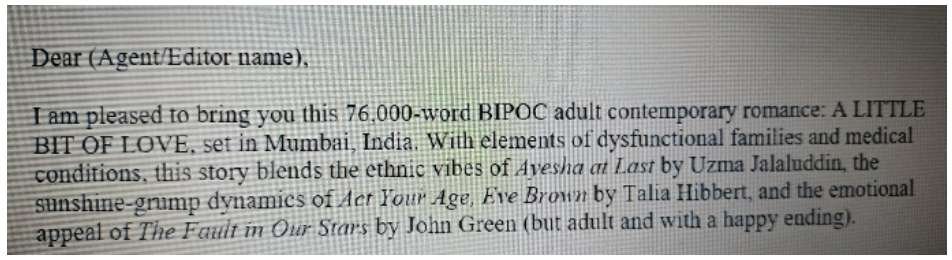
Synopsis should be ideally less than 750 words and should include all the plot points including spoilers and how it ends. Not all agents or publishers need a synopsis right away, but it is good to be prepared.
Agents and independent publishers ask for varying numbers of sample pages. Some want first 10, others want first 50. Read the instructions on their sites and follow the guidelines.
5. Where to find agents and publishers?
For traditional publishing, either you sign with an agent first, who will then sell your book to a publisher, or you can directly query independent publishers who accept un-agented authors. The publisher with whom I signed accepts un-agented submissions. Either way, do your research before signing. You can find agents and publishers on Query Tracker, websites like manuscriptwishlist.com, Reedsy, or by using hashtags like #mswl on Twitter. Make sure they accept the genre you are writing before hitting on ‘send’.
Congratulations, you’ve hit send. Welcome to the querying trenches.
6. Patience and Perseverance:
Now that you’ve sent the submission package, you wait. Waiting is crucial. Also remember that rejections are the norm in this industry. Taking breaks to preserve your mental health is important. You don’t want to burn out. I received a total of 70 rejections over a period of 11 months (I took many breaks and also did a complete rewrite of my book) before signing with my publisher.
7. Why I chose to be published with an international publisher?
Many have asked me this. They still do. I can’t explain in detail to everyone, so I only say, “Because I wanted to.”
The answer is because I can. Because even you can publish your book in the USA. The entire world is at our fingertips. So why not grab this opportunity with both hands and let our works be available to a wider audience? Besides, I did query my first manuscript (an adult rom-com) to most agents and publishers in India first. A majority of them never replied, even six to eight months down the line. During that time, I discovered the writing community of Twitter. It was then I realized, I could get my book published all over the world! But I queried that one too early (it was only 50k words) so I kept it aside and moved on to the next one.
I finished the first draft of A LITTLE BIT OF LOVE in one of the First Draft Clubs organized by the Himalayan Writing Retreat. I was stuck around 15k words on this for a long time when a friend suggested I join this. It really helped. The thrill of updating the Excel sheet kept me going. The first draft was done at 65k in September 2021. After a few revisions, it reached 70k. I began querying it in February 2022. A complete rewrite in September 2022 (I changed the POV from third to first) made the word count 76k.
Another friend suggested some international contests for debut writers. I sent my manuscript to Unbound Firsts, an imprint of Unbound (based in UK) for debut writers of color. I was thrilled when I made the shortlist. The biggest advantage of this is shortlisted manuscripts get detailed editorial feedback even if they are not chosen to be published by them. This contest will open in October, keep an eye out!
I received an offer of publication from the Shush Imprint of Shaherazad Shelves in January 2023 and I signed with them in March! Here’s the announcement:
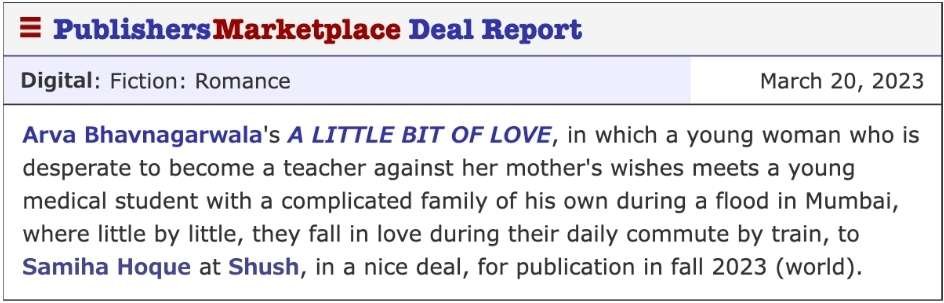
They are new and determined to publish more diverse books, and I’ve had a wonderful experience with them. If you want to query, they open for submissions in October.
To conclude, getting published abroad is hard, but not impossible. It needs a lot of patience and perseverance, but you can do this. Just like I did.
{Check out this article by bestselling author Bhaskar Chattopadhyay for some insight into his publishing journey – ‘Why I self published after traditionally publishing a dozen books?’}
We hope that Kamalini’s more traditional publishing in the UK and Arva’s Indie experience in USA give you some perspective on how you can approach getting published in UK/USA.
If you are an Indian author who has the experience of getting published in UK/USA or elsewhere, please email us at info@himalayanwritingretreat.com to share your experience with other aspiring authors.