



Introduction
Dear poet/writer, we’d love to know you better.
What are you writing?
In prose, you prefer…
To stay informed about articles related to poetry writing,
would you like to get emails from us?
We don’t spam and you can unsubscribe any time.
In prose, you prefer…
To stay informed about articles related to fiction writing,
would you like to get emails from us?
And we’re happy to throw in two free courses, too
We don’t spam and you can unsubscribe any time.
To stay informed about articles related to prose and poetry writing,
would you like to get emails from us?
And we’re happy to throw in two free courses, too
We don’t spam and you can unsubscribe any time.
To stay informed about articles related to non-fiction writing,
would you like to get emails from us?
And we’re happy to throw in two free courses, too
We don’t spam and you can unsubscribe any time.
The Himalayan Writing Retreat (HWR), the largest community for aspiring writers, has been running month-long First Draft Club (FDC) – a community writing initiative for getting that first draft out – since November 2020. In the last two and a half years, HWR has hosted 13 FDC’s, attracting over 800 participants who have cumulatively clocked about 4 million words. That’s the equivalent of 16,000 pages, about 80 paperbacks. An impressive number.
Several debutante authors got their first draft out in an FDC (Books & Awards : himalayanwritingretreat.com). At the same time, many struggle with their drafts. Advice on how to get the most out of a writing month are dime a dozen, with NanoWriMo, on which the HWR FDC is fashioned, drawing wannabe writers in droves. Write regularly, have a plan, write – don’t revise are some of the pearls of wisdom that are doled out on social media and writing groups online. Many of these border on homilies. This article takes a data driven approach to identify what works, rather than passed on wisdom, for numbers don’t lie.







FDC is not a panacea
Some basic facts before the analysis. This article analyses data from the first eight FDC’s only. The first eight FDC’s had 519 participants of which 257 got some writing done (these are referred to as Writers). This means that nearly half of the people who registered did not write a single word. Of the 257 who wrote, 107 wrote for 10 days or more during an FDC (these are referred to as Active Writers). This means that registering for an FDC does not automatically guarantee that you will get your draft out. There is only a 20% chance that you will get any meaningful writing done. How do you ensure that you are in the 20%? Read on. Before we proceed, here’s the first observation.

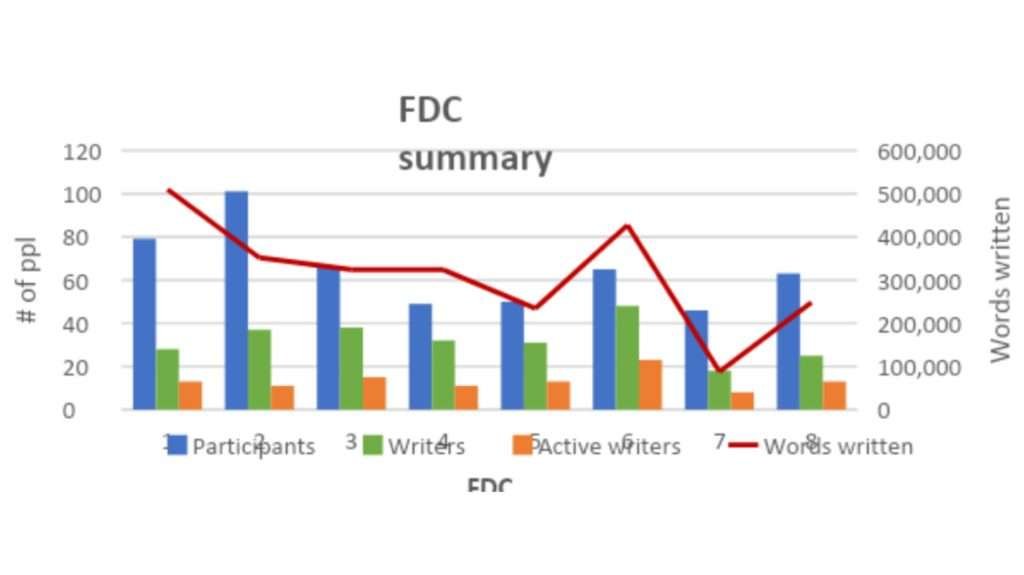
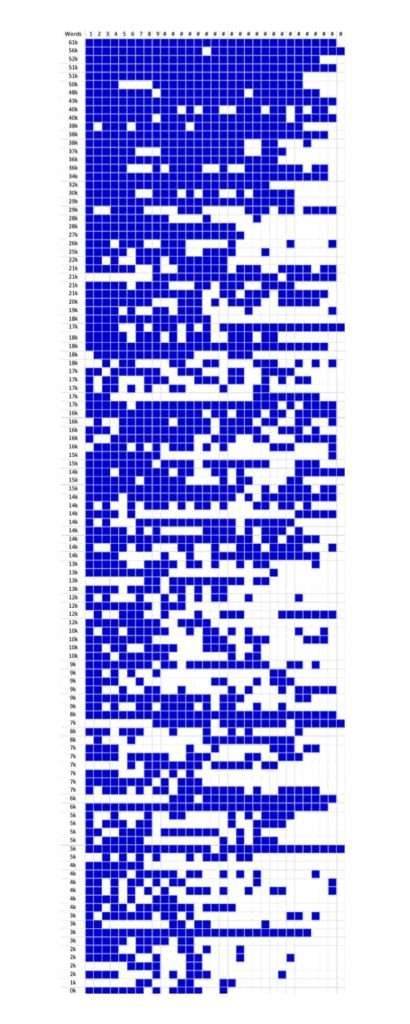
Observation 1: Registering for an FDC does not guarantee that you will write.
Making the most of the FDC
The 107 Active Writers wrote close to 2 million words out of the 2.5 million that the 257 Writers clocked. That’s 80% of the total writing done, and the equivalent of 8,000 pages, or 40 paperbacks. Now the interesting part: these 107 Active Writers wrote on an average for 18 days during the FDC month. That is writing every 2 out of 3 days. The lesson here is clear: write regularly, if you are serious about getting that first draft out. The numbers bear testimony: half of these Active Writers clocked more than 15,000 words, which is nearly half a metro-read novel – having completed half a novel, the likelihood of reaching the finish line is very high; 20 of these clocked 30,000 words or more – a full-fledged easy read paperback, and 6 participants went the whole hog – clocking 50,000 words or more – a complete novel each. This gives us the second observation.
Observation 2: Write regularly.
A tale of targets
Before the FDC month commences, every participant has to set a target word count that they intend to achieve. A common question is What target word count should I set for myself? Most of us are conditioned to set stretch goals at every stage in life: be it during our years of study, or work or even personal financial goals. Many of us even set out watches and clocks five minutes “fast” as a stretch goal to be on / ahead of time. Does this work for writing? Common sense dictates that yes, a stretch goal for writing should work. However, does data substantiate this common sense?
Data on target word-count was not collected for FDC 1, so data for FDC’s 2 – 8 have been analysed for word count vs. actual words written. A disclaimer here: I had done an analysis of FDC 3 data. This had clearly indicated that participants who set a target of 30,000 words or less wrote more often and clocked more words every time they sat down to write. These findings were presented in the opening sessions of FDC 4 and FDC 5, and the number of 30,000 has been frequently mentioned in every FDC thereafter. Therefore, the possibility of a bias skewing the results of subsequent FDC’s might exist.
At first sight, the data indicates that participants who set a higher target ended up writing more. However, when we look at the data more closely, it is apparent that participants with a low target have frequently clocked high word counts and those with a high target have clocked low word counts. The correlation between word count and words written is positive, but a weak one, 0.25 for all participants (including those who did not write), and 0.38 for those who wrote – still quite weak.


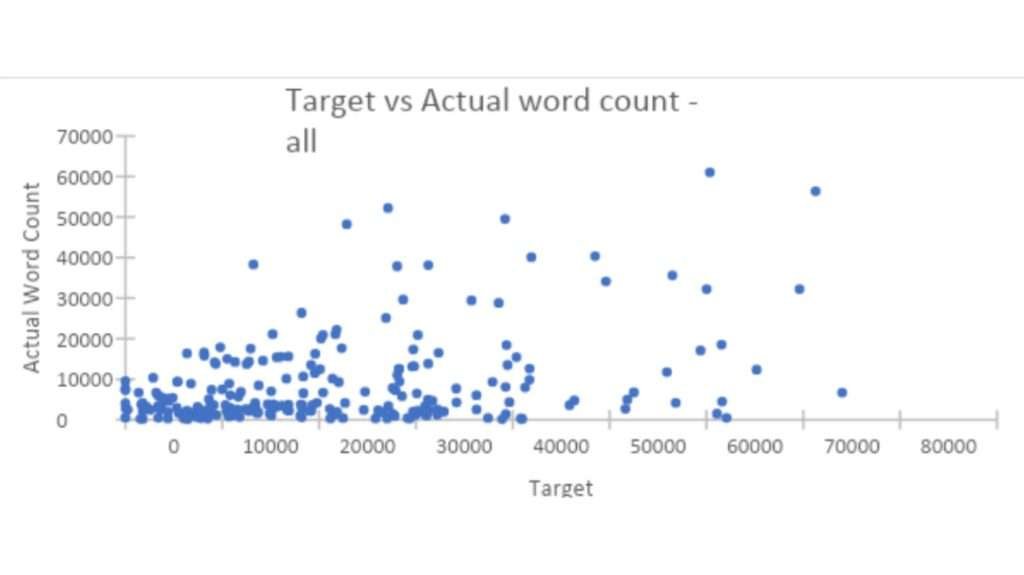
Post this we looked at many other ways to slice the data to find some intelligent patterns. We looked at the data on target vs. # of days the participants wrote.
Some trends start showing up when we look at the average words clocked per writing session, particularly the graph for those who wrote 10 or more days in an FDC. Things get
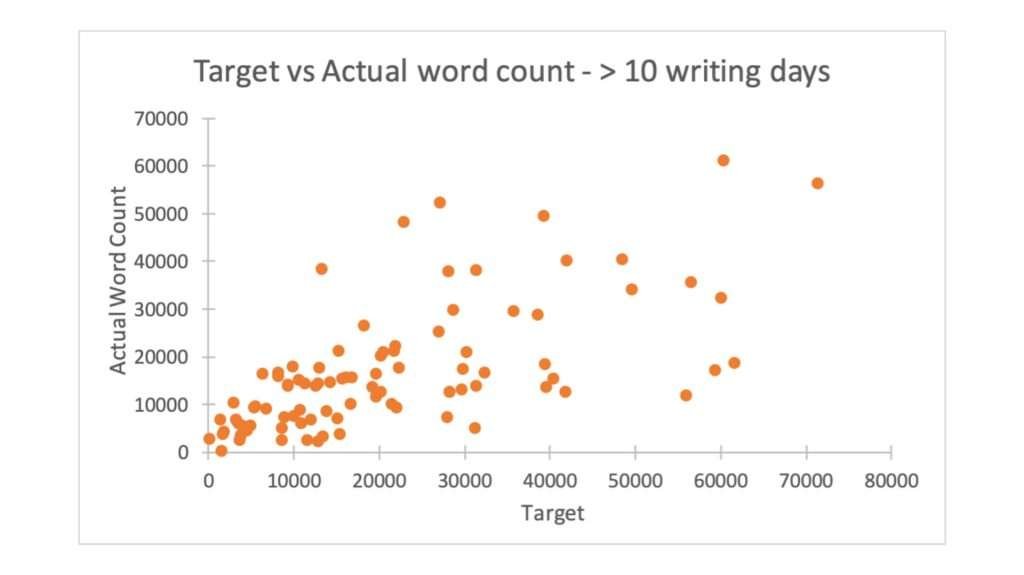
interesting around the 30,000 words target mark. Those with a target of less than 20,000 words did not write more than 1,000 words per session, and those with a target of more than 40,000 words certainly wrote more than ~700 words per session. Those in the 20,000 – 40,000 words target wrote as much, if not more, per session as those with a 50,000 plus target.
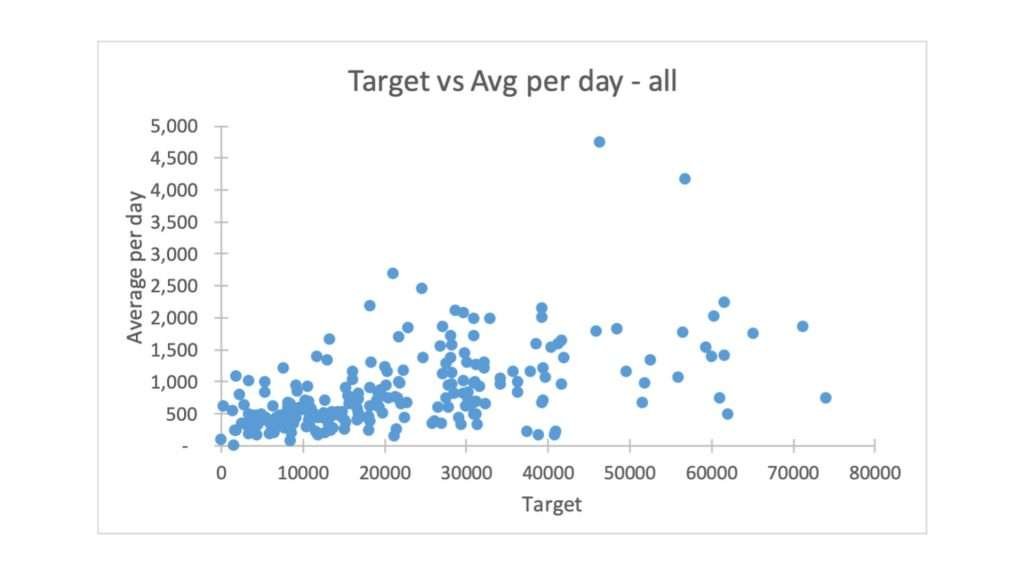
The conclusions on word count target therefore are: a) target has no impact on whether you write, how often you write or the total word count clocked; b) with a very low target, the words per writing session tend to be on the lower side and a very high target points to more words per session; and c) a target of 20k – 40k tend to write more per session.
Observation 3: Don’t sweat too much on what target to set; if you are not sure, 30,000 is a good number.
Let us now look at data that does throw up very clear trends.
Bugbears
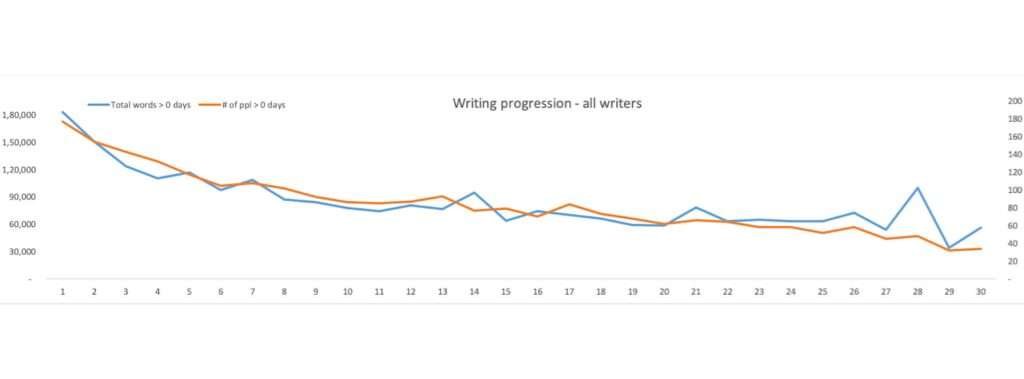
Over the duration of an FDC month, the activity dips. While the fall in writing is discernible for active writers, it is far more pronounced for the writing group as a whole.
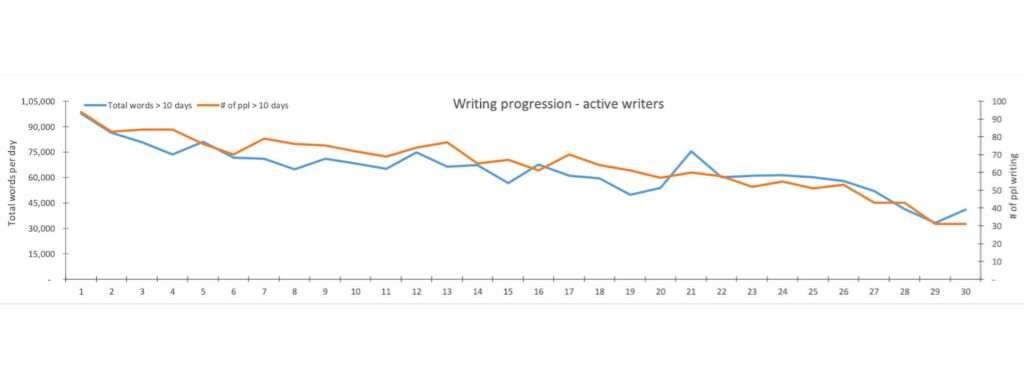
The charts show that there is a dip in both the total words clocked as well as the number of people writing. A standalone analysis of FDC 3 had shown that the dip is marked around the Day 10 mark. In subsequent FDC’s, a daily writing prompt was given to encourage people to write and this seemed to have a positive impact on the number of people writing. Therefore, the above results could be skewed by the daily prompts. However, what is clear is that as the days progress, there is a dip in the writing activity. To get a complete picture, we need to compare this with the average daily word count.
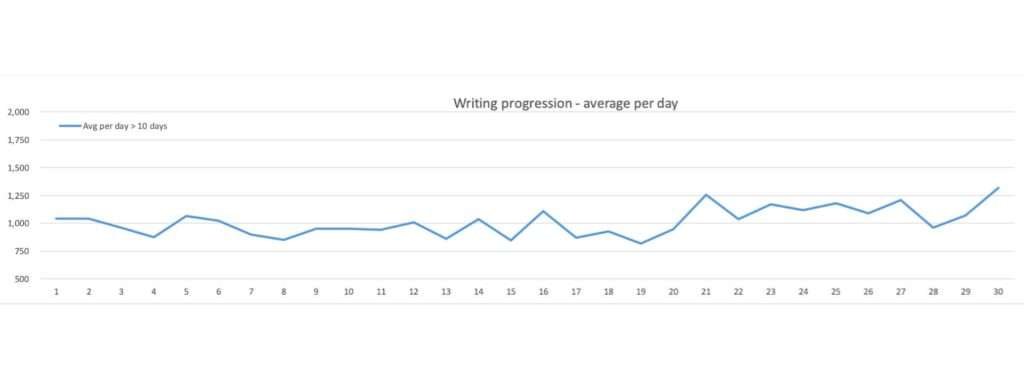
Remarkably, the daily word count for active writers does not dip much over the FDC month. On the contrary, it shows a slight upward trend towards the end of the FDC. Taking this, and the previous charts together, the dip in FDC activity can be attributed solely to people dropping out / writing less frequently as the FDC month progresses. While for active writers interest seems to flag around Day 10, for the entire population, the loss of interest is rapid in the first seven days. Therefore, it appears that if a participant can sustain his writing zeal for the first week to ten days, the writing will be consistent thereafter.
Observation 4: Watch out for the 7-day itch!
I have time over the weekend
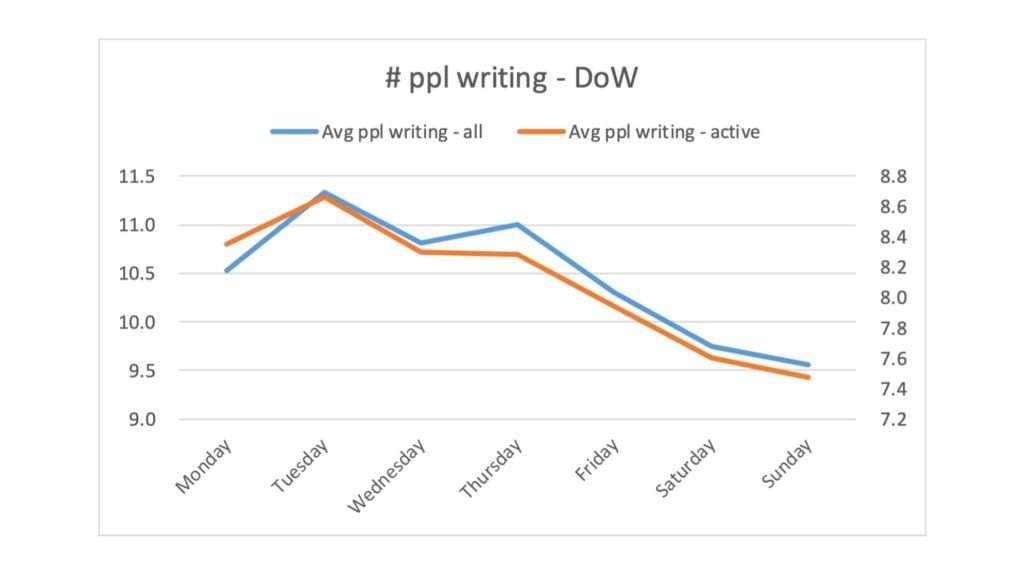
Some interesting trends surface from the writing statistics of day of the week (DoW). Both the number of people writing, and the average number of words clocked are the lowest on weekends. This is counter-intuitive, since the weekends being days off, these days should be clocking the highest writing activity. The chart here on the average number of people writing on any given DoW is telling. The trend is consistent across both active writers and all writers. The difference may look to be in decimals, but it is still substantial – almost 16%. A similar trend appears when we examine the average word counts across FDC’s on specific DoW’s and the result is more marked when we combine Fridays to the weekends: the last three days of the week clocked the top 2 average word counts on 5 occasions whereas they were in the bottom 2 average counts on 9 occasions. Curiously, Thursday seems to be the favourite DoW for writing – appearing in the top 2 word counts on 5 occasions and flitting into the bottom 2 counts only once.
| Rank average words of highest to lowest words average for DoW | |||||||
| FDC | Mon | Tue | Wed | Thu | Fri | Sat | Sun |
| FDC 1 | 1 | 2 | 6 | 5 | 7 | 3 | 4 |
| FDC 2 | 6 | 4 | 7 | 2 | 1 | 5 | 3 |
| FDC 3 | 2 | 3 | 5 | 1 | 4 | 6 | 7 |
| FDC 4 | 4 | 7 | 2 | 1 | 6 | 3 | 5 |
| FDC 5 | 5 | 4 | 3 | 2 | 6 | 7 | 1 |
| FDC 6 | 5 | 3 | 4 | 2 | 6 | 1 | 7 |
| FDC 7 | 3 | 2 | 1 | 7 | 6 | 4 | 5 |
| FDC 8 | 6 | 5 | 7 | 3 | 1 | 4 | 2 |
| # times top 2 | 2 | 2 | 2 | 5 | 2 | 1 | 2 |
| # of times bottom 2 | 2 | 1 | 3 | 1 | 5 | 2 | 2 |
The lesson therefore is that if you are putting away writing for the weekend, DON’T! You are less likely to write on the weekend than on a weekday.
Observation 5: You are least likely to write on a weekend.
Writing habits and discipline
Let us now look at writing habits and discipline. One of the lessons told is to write regularly. How does this apply to the FDC month? Of the 26 people who clocked more than 30,000 words, 21 wrote at least 7 out of the first 10 days. And not one of them wrote less than 3 days in the first 10! And of the 54 who clocked more than 15,000 words, a whopping 41 – that’s almost four fifths – wrote at least 7 days in the first 10. Only 3 were late bloomers, writing for less than 3 days in the first 10 and yet clocking 15,000 words.
| Words written | > 15 k | > 30 k | > 50k |
| Nos who wrote | 54 | 20 | 6 |
| Wrote at least 7 days in first 10 | 41 | 16 | 5 |
| Wrote less than or equal to 3 days in first 10 | 3 | 0 | 0 |
| Wrote less than or equal to 3 days in last 10 | 19 | 6 | 1 |
| Wrote at least 7 days in last 10 | 20 | 10 | 4 |
Further, as this simple table shows, you are more likely to get a lot of writing done if you get an early start:
| Days written | Average word count |
| >7 in first 10 | 19,541 |
| < 3 in first 10 | 1,132 |
Even for those who wrote regularly during the FDC month, people who got an early start clocked 1,500 words more on an average than those who tried to catch up later.
| Days written | Average word count |
| >7 in first 10, <3 in last 10 | 14,455 |
| <3 in first 10, >7 in last 10 | 12,931 |
Observation 6: Get an early start, don’t put off writing for later, thinking you will catch up.
To conclude, some traditional wisdom is corroborated by data such as to write regularly, while data is contrary to others such as to set stretch writing goals. Data also throws up some unexpected results, such as low writing output on weekends. To summarise: write regularly, set a reasonable target, get an early start, beware of the 7-day itch, and don’t put off writing to the weekend, on the FDC month-end.
Recap
A recap of the lessons:
Lesson 1: registering for the FDC does not guarantee writing!
Lesson 2: write regularly.
Lesson 3: don’t sweat over setting FDC targets; 30,000 is good if you are confused.
Lesson 4: beware the 7-day itch!
Lesson 5: don’t put off writing for the weekends – you won’t!
Lesson 6: get an early start. You are more likely to drop out rather than catch up later.
Abbreviations and terminology used
Active Writer An FDC participant who wrote on 10 or more days of the FDC month
FDC First Draft Club run by the Himalayan Writing Retreat
HWR Himalayan Writing Retreat
NanoWriMo National Writing Month, a global first draft event usually hosted in the month of November every year
Writer An FDC participant who wrote on at least one day of the FDC month
Disclaimer
The analysis presented in this article is an amateur analysis of FDC data and the statistical and analytical rigour of a research paper are not applied here. This article is not intended to be a guide, but only a collection of observations based on simple analyses and data self-filled by participants which may or may not be accurate and/or complete.
3 Responses
A very detailed analysis which will definitely help aspiring writers to get started.
Hi Dikshita,
Thanks for the interesting compilation of data on the FDC writers results.
I’ve already written a novel of about 70k words (now edited down to 55k or thereabouts) and a resource book/handbook for the higher secondary level of 80k words.Do let me know if its ok for me to join as well. I certainly will, and plan to try my best.
All the best Suman.