



You have been growing up, then just growing, at an exhilarating pace. You keep hopping on your life’s milestones at a breathtaking pace, as if the night will be over and you will still miss out on the best drink with your best pals. And then one morning, the hangover of the down-the-hill and up-the-peak railroad screeches to a sudden halt, jolting you out of your carriage. You have no choice but to look out. The scene you see is scary. You see nothing but the sky, and you do not even want to tilt the carriage to look down. Your stomach lurches and you suck all the breath back in a swift moment and sit down on the floor of the carriage and hold yourself still.
Dear poet/writer, we’d love to know you better.
What are you writing?
In prose, you prefer…
To stay informed about articles related to poetry writing,
would you like to get emails from us?
We don’t spam and you can unsubscribe any time.
In prose, you prefer…
To stay informed about articles related to fiction writing,
would you like to get emails from us?
And we’re happy to throw in two free courses, too
We don’t spam and you can unsubscribe any time.
To stay informed about articles related to prose and poetry writing,
would you like to get emails from us?
And we’re happy to throw in two free courses, too
We don’t spam and you can unsubscribe any time.
To stay informed about articles related to non-fiction writing,
would you like to get emails from us?
And we’re happy to throw in two free courses, too
We don’t spam and you can unsubscribe any time.
It was at that moment I found myself transported to a place nothing short of a temple in the clouds.
The flight took me from my shaky and scary carriage of the humdrum in Bangalore to Delhi.
From Delhi I took a second flight to Pant Nagar Airport. The airport is one of the prettiest ones I have seen, with very few scheduled flights during the day, but it is nestled very close to the Kumaon foothills which are just one hour away. I was headed to the hills, my heart taut as I started on the journey.
As I eased myself into the car and broke into a conversation with my fellow traveler, a young lad from Mumbai, also heading for the same Himalayan workshop I had signed up for, I could hear my heart’s bubbles slowing down, forming cotton candy clouds and starting to weave a softer nest for my anxiety.
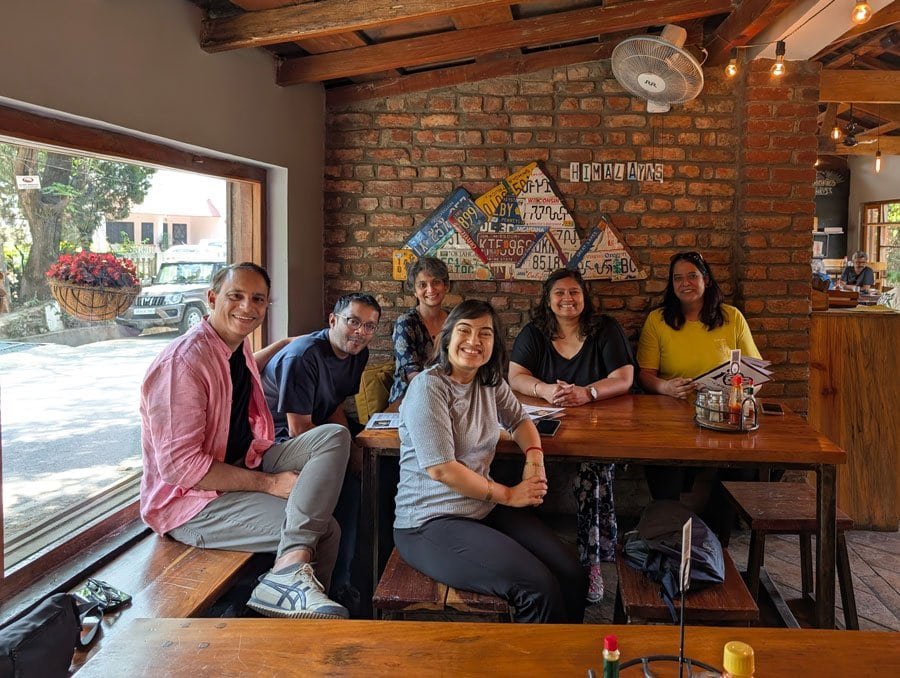
Just as we reached the busy junction of Bhimtal, we stopped. A quaint café, I ❤️ Café, looked over the Kumaon hills and opened its doors for us. All three cars we had filled up in, and were tumbling upwards, took a break to stretch our limbs, take pee breaks, and nibble on their sweet and savoury offerings. We had some big laughs, and as eyes twinkled in the morning’s soft light and hands touched each other and pulled each other in for some group shots, the links were being slowly joined, without anyone noticing. We were busy drinking in the scenery, the air, the coolness of the tall shadows of the chirs and deodars.
The short pit-stop over, our cars again zoomed up at a fast pace through the sun-dappled hairpin bends, up and up the Himalaya. My stomach seemed not too happy and was feeling a little nauseous, but as I asked our driver to slow the pace down, it helped me ease until he pulled up to a bit of a kachha ground where we were greeted by two big doggies and their way of saying welcome home. I am usually terrified of any kind of canine, and yet I fell instantly in love and let them sniff and lead me down the gravelly path by the fruit orchards.







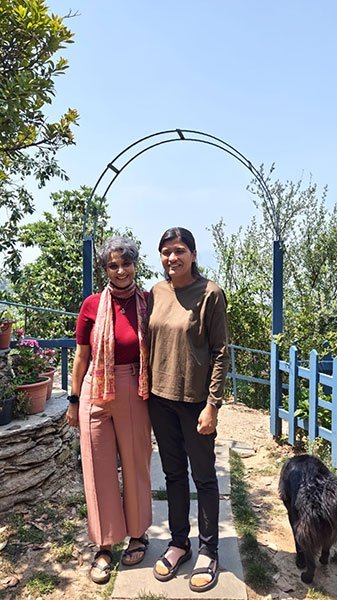
Renu, the ever-smiling, all-warmth-exuding manager of this well-kept secret place — also known as — The Himalayan Writing Retreat — would not allow any of us to carry the small trolley bags we had packed for the four-day workshop. She made sure everyone had parked their luggage near the cars, and she and two other boys from the stay carried it in for us. Once I grew friendlier with them by the end of my stay, I would not let them do it all by themselves. But that is another four days later.
For now, we, like a chain of ants, walked behind the canines to reach a gate arched in blue against the wide, wide blue sky. There was no end, even beyond the 360-degree view.
We streamed in and took a seat on the rocky ledge shaded by the green creeping all along, the canines happy to have got us home, settled in commas against our feet.
As Ameen, our sutradhar, guide, and mentor for the Storytelling workshop in the Himalaya, reached the ledge where we had settled in, he checked in with Renu on whether all the rooms had been allocated as requested. As we signed our names against the rooms, named after the maestros of literature and philosophy — Ismat, Kabir, Cohen, Orwell, Agatha, and Ghalib — it felt humbling to be in their abode.
We walked down a couple of stairs and up a few steps — all along the path, the giant hydrangeas bowing and brushing and whispering and giggling to greet us.
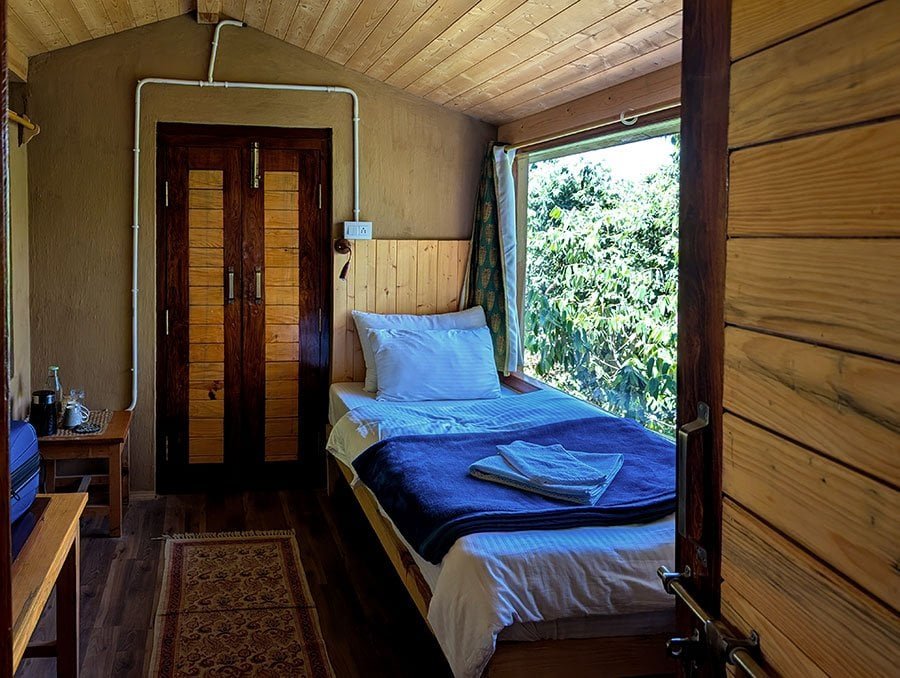
We peeked into our mud houses that looked more like hobbit-holes from outside, and exactly like the smials, as soon as we pushed open the wooden doors against the hinges, they opened up to big windows looking into the woods, the mountains standing tall behind them. The feeling was nothing like the feeling of the carriage hanging at the top of the cliff with only the sky visible. Here, the ground and the sky met each other with a softness and a melancholy of hues unseen.
We washed away the tiredness with a splash of cold water, and as I sat on the toilet seat, I read a thoughtful note on water and electricity usage and felt a sudden attunement to the planet. I know it sounds strange, but that, I believe, is what the whole place does to you.
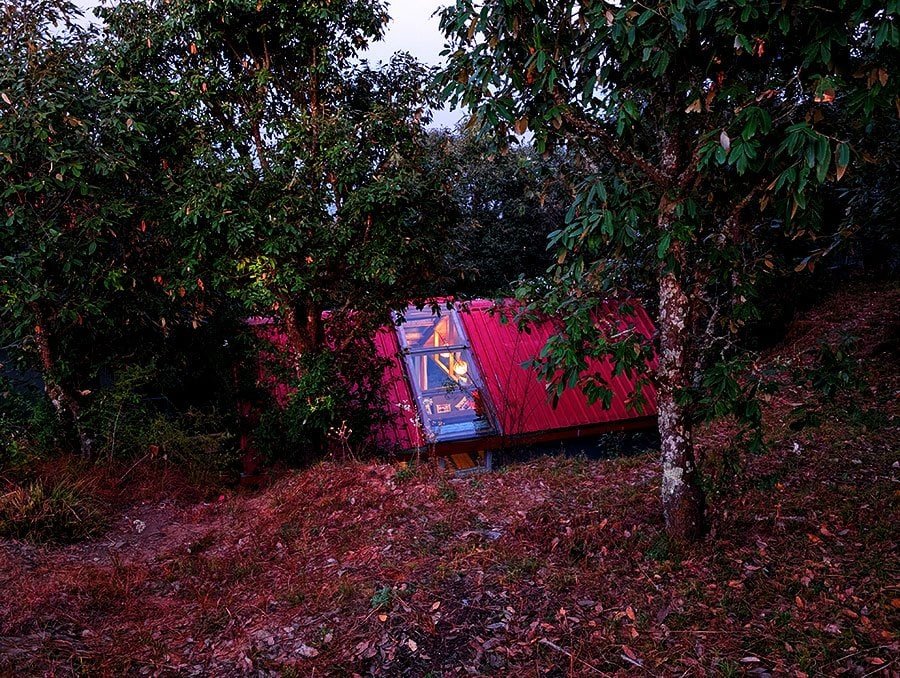
Coming back up, we saw Ameen already seated inside the glass hall, which I have named The Study Hall. Back in my college days, we had made a day trip to Shantiniketan — the abode of our Nobel laureate poet Kabiguru Rabindranath Tagore. It was there, for the first time in my life, that I saw the Upasana Griha — literally translating to prayer hall. A quaint building amongst all the greenery and red mud paths that make up Visva-Bharati University, it is made up of painted glass and beautiful ironwork. Somehow, it evoked a strange devotion in me that I had never felt upon visiting any temple in my life. I felt that same strong emotion again as I approached the Study Hall, with its red roof, the sun seeping through the skylight, peeking through the unencumbered branches and leaves.
I made the acquaintance of Vandita, the co-owner of The Himalayan Writing Retreat, and Anhad, her son, who had just passed out of school, ready to take on the world.
We made ourselves comfortable around the sofas, laid out so we could all face each other, rest comfortably after the long journey, and enjoy a warm, simple lunch prepared by Anand Bhaiya — the head chef, who is even shyer than a new bride, only gleaming a quick flash of a smile as we complimented him and poured ourselves second helpings.
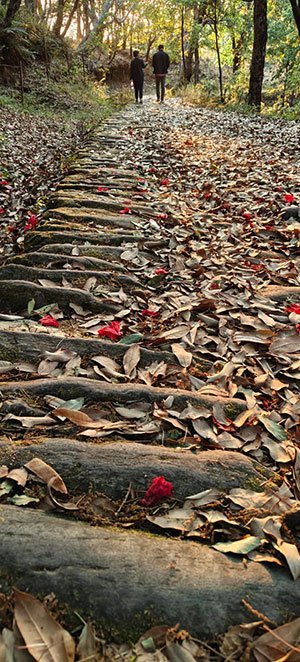
That evening, we went for a long walk to Mukteshwar, partly on foot, partly by car, and then all the way back on foot. As we meandered over the dried leaves along the stony, spiraling roads, listening to the birds calling out to each other, tapping the bark, the rustle of leaves at our feet, we slowly started growing roots into the place, and the place into us.
After the walk and tea-break, we began, as a group, to embark on a journey of storytelling. None of us knew what that entailed, and yet we somehow knew.
Darkness falls quickly at high altitudes; the sun drops down with the velocity of an object in the hands of a toddler, and coldness gathers around you. But the introductions of each of us, Ameen’s voice tracing the folds of the Himalayas outside, rising and falling, kept us close, perfectly matching the character of the setting and replenishing the heat of our huddle.
As the workshop progressed each day, we settled into a gentle routine of not hurrying, of always taking a moment to check on each other, yet keeping pace with the sun’s arc across the day. The workshop was titled The Storyteller’s Way. Each session was crafted around how to tell better stories, what stories stand for in today’s world of diminishing attention, and how to carry your story and give it a voice. We studied different mediums of storytelling, starting with the ancient tablets that told the story of Gilgamesh, all the way to modern-day thirty-second shorts, with films and advertisements in between, capturing stories for different purposes.
As one day progressed into the next, I noticed I was gaining a fervor for putting my thoughts into words, better with each exercise. I wondered if it was the work of the thin air, or of Ameen the magician, weaving the air into small enchantments. The group had become cohesive, learning to identify each other’s strengths, and slowly we embarked on a journey of holding each other up and taking on the responsibility of keeping each other’s stories safe.
Every evening we took walks along the mountainsides, sometimes reaching towards nothing, sometimes chasing the sun, sometimes the freshly fried samosas. Each sunset taught us to let go and create, to let go and create, and keep the cycle repeating.
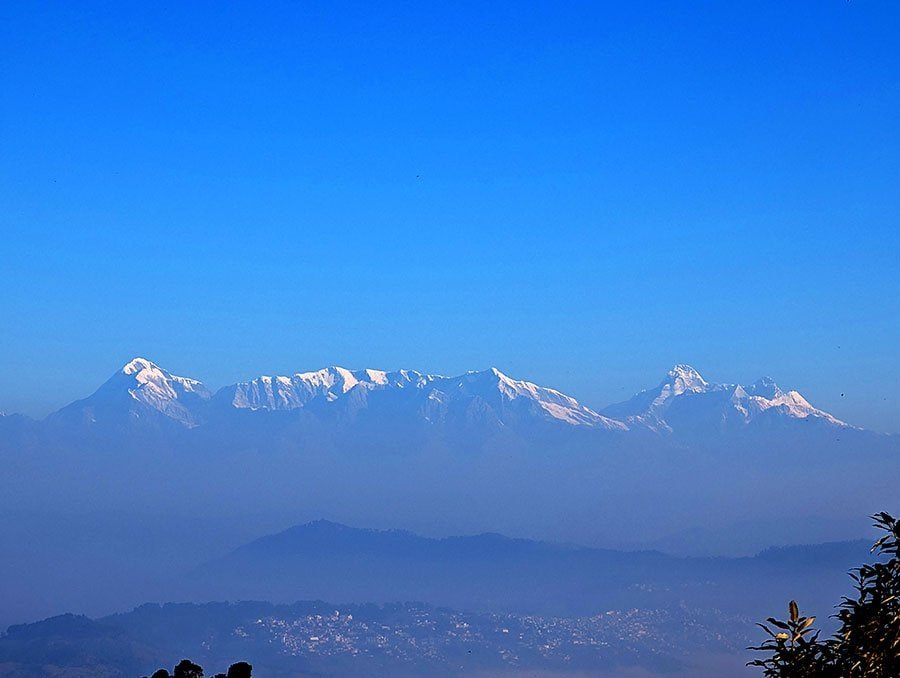
The dusk, the sundown, the orange-pink of the sky, the hands held, the words shared, the songs sung, all against the backdrop of the Nanda Devi Range watching over us — still sends a thrill down my spine as I sit here writing this.
Every single day we were there, we were fed sumptuously by Anand Bhaiya and his two accomplices — Digar and Prakash — a new menu spawned every day from fresh, locally sourced ingredients, made with a lot of heart. I was completely hooked on their citrus punch – a home-made Himalayan concoction which I had with warm water almost twice a day.
Tea and coffee were never in short supply, and evenings brought pakoras or cutlets or some other snack followed by soup as an appetizer to dinner. More than anything else, we felt ourselves rejuvenating, not only in mind but also in body. I, who can hardly eat anything post-sundown, felt hungry every day at soup hour, and the meals nourished my soul. The Himalaya workshop came with a Himalayan Kitchen, and a Himalayan appetite.
At the end of the four days, I did not know what I had learnt, but I knew I had become someone else. I found it hard to recognize my own self, and that realization of transformation was slow, unfolding over the next three to four months after I returned to my daily humdrum. By then, I knew I would never be the same person again.
The beauty of the Himalaya I had witnessed, the starry nights, the lights of Almora, every waft of breeze that had touched me, kept calling me back into its embrace, and I could not look away.
So, by the end of the year, I found myself drawn again towards that same route — up the hills, into the embrace of my kind of people. This time, Vandita was not only the owner and my cohort member, but also the workshop mentor and guide. The workshop was named “Write to Heal and Grow“.
Having known Vandita from the past workshop, where she had attended as a participant, I had come to know of her grounding in psychology, and this time I wanted to do a complete cartwheel and give myself up to the Himalaya, to the healing power of the altitude, and to Vandita’s skill. And I was not wrong.
The group was smaller and more intense than the last time around. Yet we did not hesitate to have good laughs, to plan sunrises together in the biting cold of November, in the numbness of the chill in the wind. Prakash bhai kept the Bukhari (wood burning stove used to heat the room) going every time the draft caught up and bit our ears. The sun now went down earlier and much quicker, and yet we had not stopped chasing it.
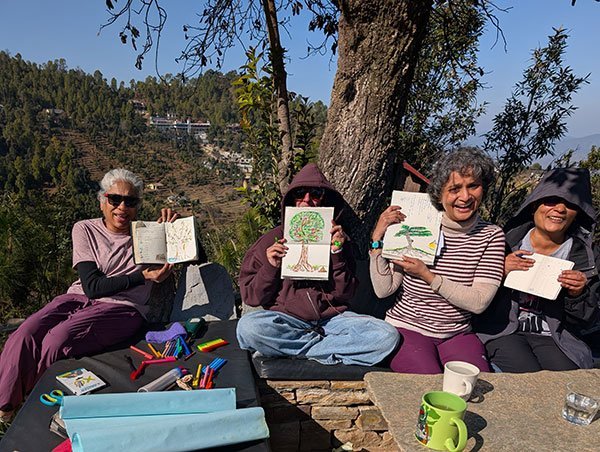
The November mornings brought up the sun late. Early morning, after a shivering shower under the grace of hot water, I would pull on my Smartwool long socks and step outside to be met by Zaya — and even Zaya would not bark, as if reflecting the serenity of the Himalaya , the peace of the forests, the chirps of the slowly waking birds, the flapping wings of the butterflies, the swoosh of the wind. Everything spoke with a reverence to the morning. And I just stood there, witnessing the moment, being present with them.
Every day of this uniquely crafted workshop by Vandita helped us peel off the cutaneous and subcutaneous layers of ourselves that we had curated for so long, without ever realizing the weight of what we were carrying around. Each exercise was so meaningfully designed — through art, through poetry, through the sharing of memory and objects, and just through being in nature, meditating — a complete reset of body and mind. The Himalaya, workshop, and Vandita’s expertise somehow opened us up. Vandita, in her thoughtful way, nudged us to come to terms with our inner selves, recognize what was gnawing at us, pardon ourselves and others, cry, smile, and heal.
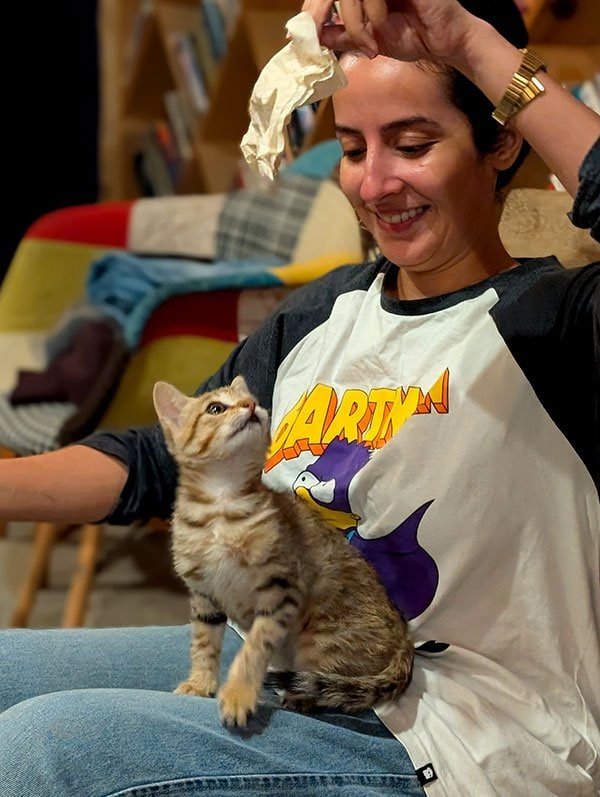
Anand Bhaiya did not fail this time either, serving finger-licking, lip-smacking, wholesome food as always. This time, Zaya (the youngest of the canines) and I became quite close. She would follow me around from sunup to sundown. The retreat also had a new pet in Belle, a feline, and the gnawing and tussling between Zaya and Belle was a treat to watch. Belle took a cozy nap in one of my cohort member’s sweatshirts, waking up only to make Zaya jealous.
Nature works in mysterious ways. In my childhood, I had read a Ruskin Bond book, “Time Stops at Shamli“. Visiting The Himalayan Writing Retreat and spending a couple of weeks in the lush of the Himalaya , in two very different seasons, made me actually live inside those stories that had enchanted my childhood.
If you ever feel, as I did, your carriage come to a jolt and hang suspended halfway in the sky, please take it as a sign. Make the pilgrimage up the hills, where the nightfall calls your name, to the Kumaon Hills, to the Study Hall, the temple like no other — The Himalayan Writing Retreat — and find yourself again. Let it be the Musafir Café for you and your soul.