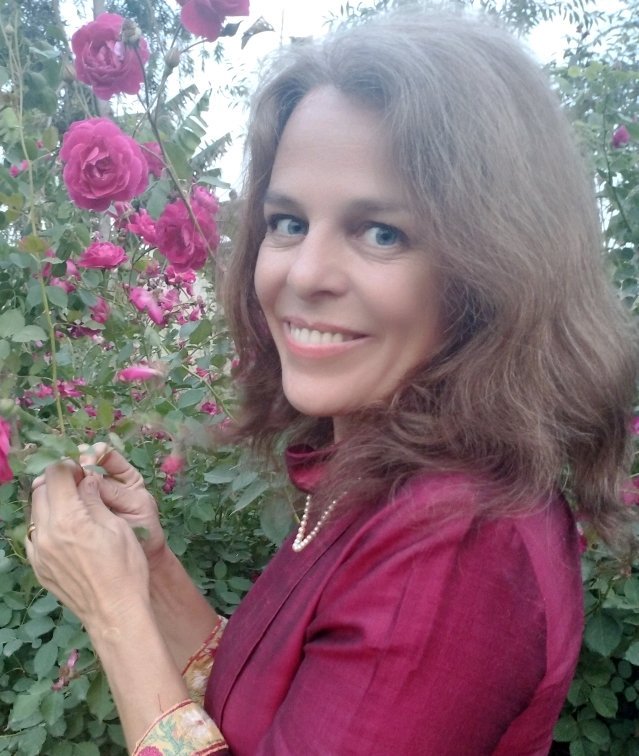
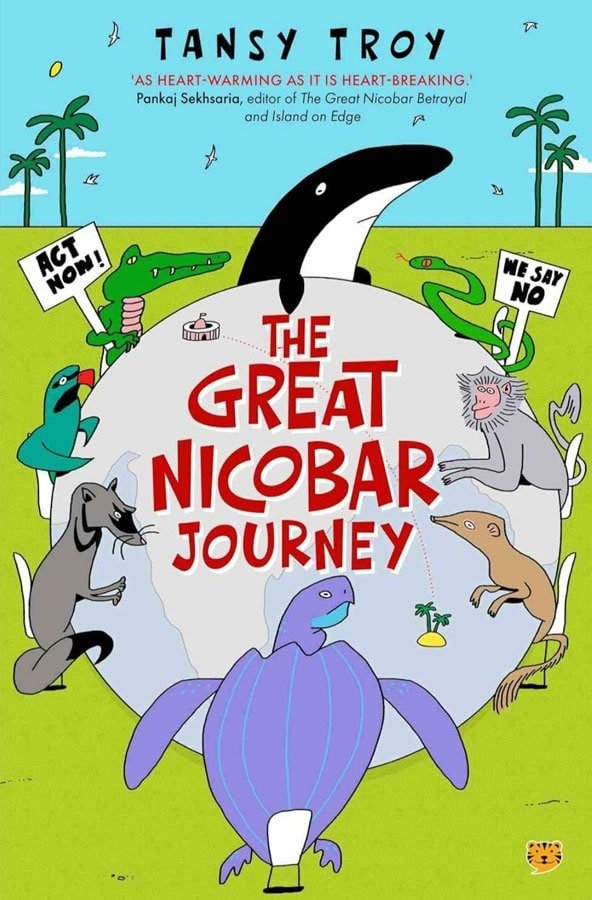
This year, I have met a great many rare and endangered species endemic to Great Nicobar in, believe it or not, the nation’s capital city, New Delhi. I interviewed these brave, intrepid creatures as they concluded their epic protest march from Great Nicobar to the Sansad Bhavan, where they petitioned the powers-that-be with song, poetry and great magic in a monumental effort to help protect and save their precious emerald isle in the face of its imminent destruction. The tales they told me are published for all to read in a novel for the young of heart (all ages welcome), published by Talking Cub, an imprint of Speaking Tiger, this summer. But how, I hear you ask, did you learn to speak multispecies? Which course teaches this eclectic translation course? Well, let’s just say that Ranjit Hoskote’s Nature Writing at the Himalayan Writer’s Retreat last year in March and the subsequent First Draft Club #22 were all instrumental in my recent linguistic re-education and subsequent fluency in multispecies-speak.
Dear poet/writer, we’d love to know you better.
What are you writing?
In prose, you prefer…
To stay informed about articles related to poetry writing,
would you like to get emails from us?
We don’t spam and you can unsubscribe any time.
In prose, you prefer…
To stay informed about articles related to fiction writing,
would you like to get emails from us?
And we’re happy to throw in two free courses, too
We don’t spam and you can unsubscribe any time.
To stay informed about articles related to prose and poetry writing,
would you like to get emails from us?
And we’re happy to throw in two free courses, too
We don’t spam and you can unsubscribe any time.
To stay informed about articles related to non-fiction writing,
would you like to get emails from us?
And we’re happy to throw in two free courses, too
We don’t spam and you can unsubscribe any time.
Ranjit himself put it best when he explained to us, as a group that ‘the ecological catastrophe that we, as a species, have triggered off is arguably the single most important strand within the polycrisis of this epoch. It is vital that, as writers, we address… and find ways of bearing witness to this situation, to our own responsibility and indeed our culpability within this… and to possibilities of amelioration and redemption.’
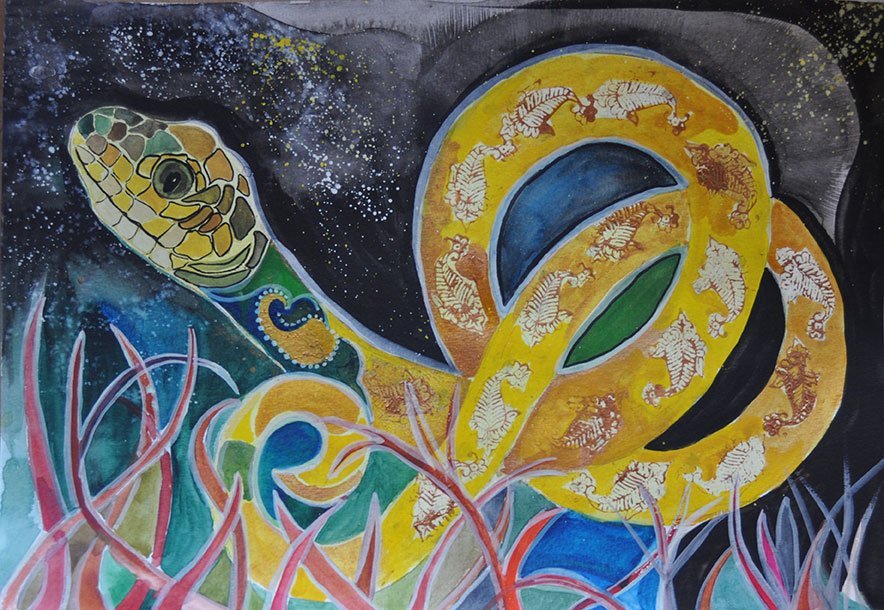
As I mentioned, I wasn’t always so confident about speaking in first bird and animal, even after eight years of listening hard to the pitiful cries of woe of fellow creatures while bearing witness to the willful destruction of my place of residence in Rohtak, Haryana. I poured my outrage into three books of poetic sorrow and hope and articles in a dozen mainstream broadsheets and magazines. I was onlooker, horrified spectator, living safely protected enough as I did in a gated campus, teaching children of the elite while around me, fields in which chital had once roamed and grazed free were tarmac-ed over and made into playgrounds for humans. An unused golf-course once high with wild grasses, inhabited by powerful golden hares was razed overnight to protect the children from potential snake attack. Exquisite passerines fell from the skies, mid-flight, after ingesting berries laden with pesticides. Around our ‘protected’ campus, highways sprang out of nowhere until the last marshes, safe-havens of red-necked cranes were cemented over to become fast tracks to the metropolis, a one-way street to the end of the world as we knew it.







Our Himalayan hide-away, the place to which we retreated in the holidays, was also becoming an impossible-to-keep secret. On each successive journey home, I would watch as entire hillsides were torn open to enable tunnels through the Himalayas. Wayside forests of lychee, mango, oak and rhododendron were savaged to widen roads until they gaped, hungry for more vehicles filled with tourists, who in turn were filled with craving for fresh air and peace of mind, payed for the experience with more and more rupees destined to fund yet more development.
Head in hands at my workaday desk, I despaired. Only the children could cheer me. We performed eco-dramas and toured them around theatres and festivals across India and wrote poems and articles to fill an eco magazine printed on khadi paper, hand-bound in the backstreets of South-ex.
Yet I still felt the need for the support of a like-minded community of writers. The email from the Himalayan Writing Retreat offering Ranjit’s course suggested that I might just find it up in the hills of Satkhol.
On the first day of the retreat, Ranjit explains the very vital importance of calling out the crisis we as a species are capitulating. ‘Here, we stand in the presence of nature-in-itself – the panoramic vista of the snow-capped Nanda Devi range, the serene clouds, the miles and miles of oak and pine forest – even as we recognise the unmistakable signs of human interference in nature. We recognize that the glaciers are shrinking; we see the forest fires flare up in the valleys; we walk along a path that was scorched by a forest fire not two weeks before, leaving charred rhododendron shrubs and cindered pine behind. Nature, here, is neither an idyllic tabula rasa waiting for us to inscribe it, nor is it a radically alien and forbidding wilderness. As writers, we are able to experience the close weave of the tame and the wild, the cultivated and the forested – as we walk around, taking in the sensory impressions of this landscape, we see that oak groves and small farm holdings are adjacent and even intersected. We hear the distinctive sawing growl of leopards and the lowing of cows and calves, predators and livestock in close adjacency. We receive a visceral awareness of how nature claims and affects us, and how we have claimed and affected nature – this is not available in such an immediate and full-bodied manner at a distance, in the comfort of the city, the library, the archive. Even in microcosm, our days at Satkhol draw us into the complex tapestry of the inter-species interrelationships that sustain ‘nature’.’
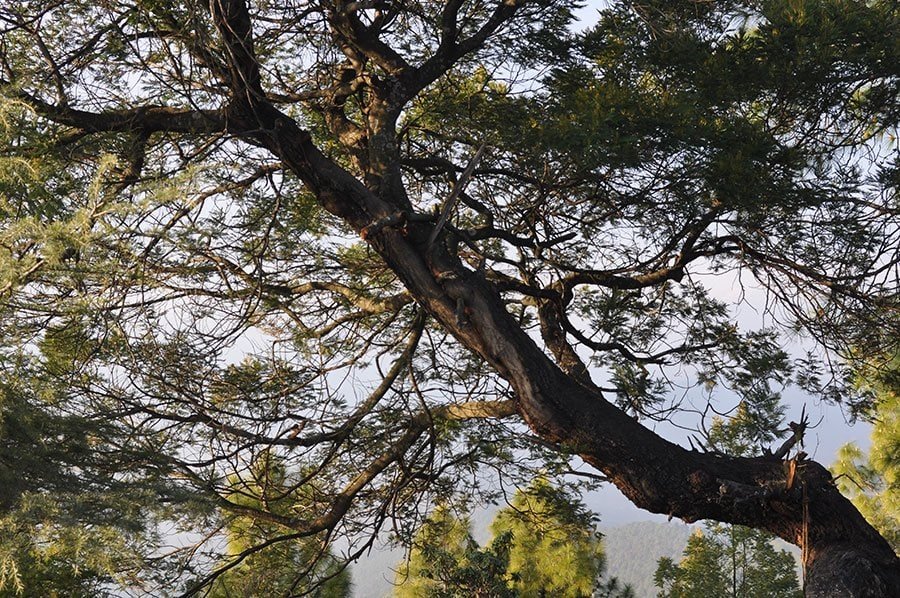
On the second day, Ranjit sends us all out into the semi-wilderness to document whatever we can see. He tells us to return back to the camp ‘as if blindfolded’: writing without the faculty of sight. The smell of Earth envelops me until I am small enough to fill an acorn cup and large enough to embody the Himalaya. Birdsong fills my being. Blossom enters my heart.
Nature Journal IX: Finding the way home, blindfold.
That familiar, unknowable shuffle of wind through the pine needles, a different sound to when it hustles leaves.
A bafflement.
That swell, starting so innocently, we could be lulled into thinking the way home will be a breeze.
Birds continue to sing.
Warmth continues to trickle through the cervices behind my ears, down the gradient of back.
That once distant whistle intensifies and soon, this world we used to have to see to believe is suddenly negotiable only by sound, by scent, by touch.
The bass and treble of blow and shiver sweeps all before it in gusty passages known only to inhabitants of air.
Smell of home, of blood, of earthscent on air, guide us back to base.
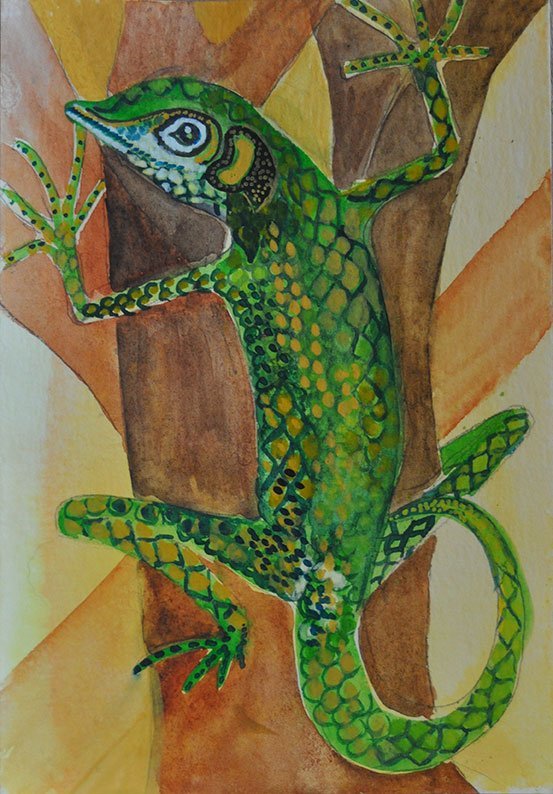
Reading back my witness account to the group, Ranjit gently suggests going deeper, exploring the voice of bird through becoming bird myself. Simultaneously, I am working on a series of water-colours for Frontline Magazine, of endangered species from Great Nicobar. Their accompanying poems suddenly find their power as I change them from human perspective odes to their own voice, first animal cries for support. This shift from being observer to a medium, to embodying species other than myself feels shamanistic. It is profound enough to propel me into a state of high fever of hallucinogenic proportions and I spend the final day of the retreat burning and freezing with equal intensity, coughing up all the smog and dust the city ever offered while kind members of the group squeeze me lemons fresh from the tree and look after my daughter as if she is their own.
After all the words
spoken aloud, scribed in sap
forest invites sleep
Fever, fire, burnt
trees, offer antidote to
blossom, ripe lemons
A month or so later, HWR advertises its First Draft Club 22. I had attended one other so I kind of know the set-up. The fee is nominal and goes directly to a local NGO school. Chetan, co founder of HWR tells me that the First Draft Club fees fund 60% of the pupils tuition in a year. In this one I am about to sign up to, Ranjit himself is giving the first Sunday lecture and meeting him again online, along with other members of the Nature Writing retreat feels like a joyful reunion. I experience that familiar sense of being held and nurtured, intellectually supported by a whole community.
The members of this latest club soon split into organically organized whatsapp groups- script-writers in one, novelists in another, one group of memoir writers and another of poets. I soft-land neatly into the latter group, because, I think fondly, this is surely what I am by now: a poet. Still concerned with the Nicobar crisis, I write my own version of the 12th Century conference of the birds.
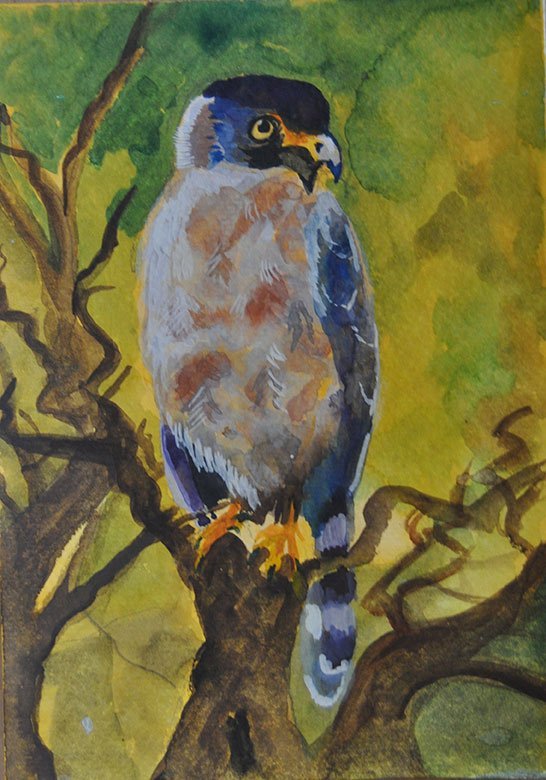
We have flown far to conference with you:
to speak not only of our plight, instead
of your own species annihilation.
You may suppose we did not know your plans
for Sambelong: but we belong here, hear
the rootspeak, tremble in the leaf litter
and premonition in ragged cloud.
You might not have thought we would actually notice,
yet if not in storm uneasy tremour,
how would our life as birds have seen us through
eight valleys until we happened upon ourselves
face to face,
wing to wing.
We realised our quest generations ago.
Now we come to alert you, avert you
advise you to take this moment to pause.
What do you want your reflection to show?
A razed forest in your chest, charred stumps for arms, legs
thrusting from your deadened earth void of sound,
void of multitude, head a dearth, though once
your bounty knew no bounds and rooted things,
like memories, took you back to beginnings.
Look again with closed eyes now and listen.
Listen like your life depended on it.
Hear our riotous song in every key
rebinding your severed neural pathways.
We reveal you to yourself, earth-being;
lest you become forsaken in scorched lands
you wittingly ravaged, we bring to you
our conference.
I write a sonnet spell for the Shompen.
Each grain of sand a universe unbound
a coral bead strung onto sacred cord
meandering round, protecting all my isle
from centuries of seasoned harangue and harm;
how vulnerable that tenuous string
since higher tides and deeper disturbance
threatens our continuous lineage:
arboreal state, each tree full laden
with bird, mammal, insect, plant, leaf, fruit;
no mythic Eden requisite when
such intertwined delights as ours abound,
on this fecund archipelago:
I call upon oceans to outwit Time:
rise, vibrant tides. Spread wide your rime.
And then, out of the blue, it arrives. A story. A tale about a band of animals so saddened by the plans to desecrate their home, that they decide to cross the ocean to the mainland and petition the powers that be in Delhi.
‘I’ve written 3,000 words today!’ I crow excitedly on the First Draft Club #22 group. ‘And guess what? Not poems. A short story. Feels like it might have something.’
After that, things happen at high speed. Within a week, I have a draft I feel is in a good enough place to send out as a pitch to the legendary Sudeshna Shome Ghosh as Speaking Tiger. Within a fortnight, she has responded generously. The 3,000 words are going to have to become 30,000 for her to consider publishing, but if I’m up for the challenge, then it’s a possible ‘yes’. Of course, I will have to go to Delhi and interview Nicobar Treeshrew, Cat Snake, Civet Cat, Long-tailed Macaque and Nicobar Parakeet to get the authentic story – I will have to hang out at the Sansad Bhavan- and I will have to make my own placards and go on demonstrations along with the animals to really make this story sing- but if I’m prepared to go this far, then maybe, just maybe, the story will indeed have something.
This summer, in June 2026, The Great Nicobar Journey made its way to independent bookshops across India. It is illustrated with maps and pen & ink sketches of the birds, animals and reptiles on their great adventure. It includes poems and songs written during the Nature Writing Retreat and First draft club 22.
I write this post in gratitude for the kindness of my teachers, the patience of fellow writers, poets and painters, who joined me on my journey. I realise now that there is nothing quite like a writerly community to support a story along the way. And a community which has its base surrounded by fruit trees and encircled by Himalayan majesty deserves recognition, appreciation and bahout, bahout metta. So to Ranjit, Chetan, Vandita and all those who accompany the great journey, Danyavad, O Jullay, Thuke je, Shukria, Merci, Thank you and most of all, in every multispecies tongue known to the Earth – in every billclatter, crowcaw, roar-hum-whistle-chirrup- meowl-hiss-croak ever heard- metta from the depths of my heart.
Tansy Troy is an India-based educator, writer, illustrator and poet. She edits young people’s eco journal, The Apple Press, and publishes poetry, reviews and articles regularly in many leading broadsheets and magazines including Frontline, Sanctuary Asia, Open Magazine, HT, The Hindu, Punch Magazine, The Chakkar, Usawa and Art Amour.
When school is out, she nests with her family of many beautiful animals (and a few humans too) in the mighty Himalayas.