



Amazon Advertising for Books – An Overview
How to sell books on Amazon India?’ – Does this question haunt you as an author? Amazon Ad is the most effective because because the platform is full of customers who are already in the “purchase” mindset. Unlike social media platforms like Instagram or Facebook where users looking for entertainment, customers on Amazon are ready to make a purchase. They are actively searching for products, reading reviews and comparing options with the intention of buying.
Dear poet/writer, we’d love to know you better.
What are you writing?
In prose, you prefer…
To stay informed about articles related to poetry writing,
would you like to get emails from us?
We don’t spam and you can unsubscribe any time.
In prose, you prefer…
To stay informed about articles related to fiction writing,
would you like to get emails from us?
And we’re happy to throw in two free courses, too
We don’t spam and you can unsubscribe any time.
To stay informed about articles related to prose and poetry writing,
would you like to get emails from us?
And we’re happy to throw in two free courses, too
We don’t spam and you can unsubscribe any time.
To stay informed about articles related to non-fiction writing,
would you like to get emails from us?
And we’re happy to throw in two free courses, too
We don’t spam and you can unsubscribe any time.
Imagine you’re a self help author who has written a book titled “Unlock Your Potential: Journey to Your Best Self”. You want to get your book in the hands of as many readers as possible. For the keyword “self help” alone there are an estimated 2 million global searches. Imagine getting your hands on just 1% of the audience. That’s a staggering 20,000 copies sold! And you can do it just using Amazon Ads. There is only a small prerequisite: have a book that will compel people to push that “buy now” button.
At Aurelius Media, I have worked with several published authors from publishing houses such as HarperCollins, Penguin Random House, Bloomsbury, River Head and more. In the last few years I have tested quite a few ad formats and strategies that resulted in several bestsellers.
Among these strategies, Amazon Ads ranks quite highly and the purpose of this article is to show you the exact strategies that worked for our clients. In this article, I will breakdown the most effective Amazon Ads strategies that will help you sell your books on Amazon.in. you can deploy to promote your books.
If you are new to Amazon Publishing, check out our post on ‘How to Publish an eBook on Amazon in India? – A four-step guide’.
There are mainly two kinds of campaigns you should be aware of in Amazon Ads.
- Sponsored Products
- Sponsored Brands
In our experience Sponsored Products always outperforms any other ad type on Amazon. This is where 80% of your marketing budget should go towards and : mastering Sponsored Products will be the core focus of this article.







Sponsored Products
Sponsored Product campaigns are the easiest to create and also the most effective in helping you sell your books. Sponsored product ads are the ads which are displayed to a customer who is searching for a product using a relevant keyword or viewing a similar product. For example: below is a sponsored product result when one searches for the keyword “self help” on Amazon
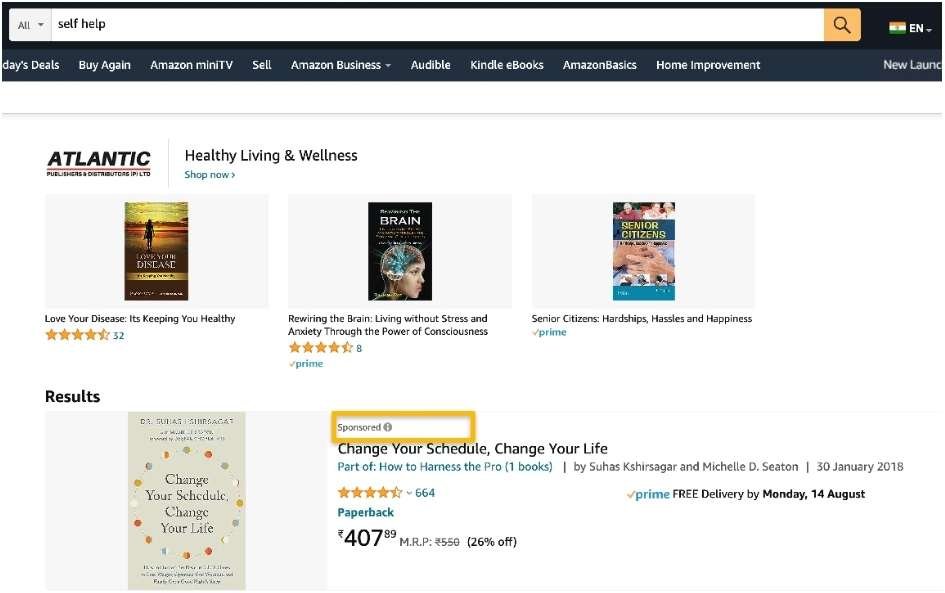
(Example: the customer is searching for “self help” books)
And here is an example of sponsored product ads shown as “related products” on a product page of the book “The Psychology of Money”
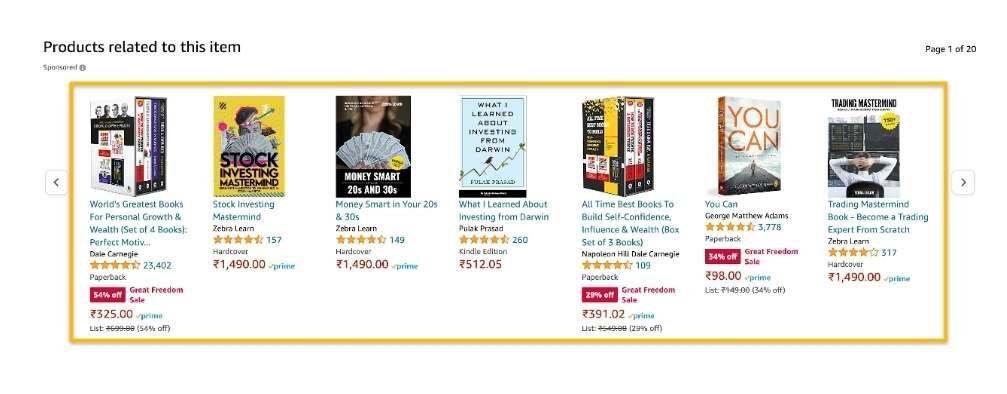
As you can see, these ads are highly targeted and tend to blend in with the organic search results. This makes them less intrusive and more likely to be clicked by potential customers. The only thing that sets apart sponsored ads from organic results is the “sponsored” label. The reason why Amazon ads are so effective when you are trying to sell books on Amazon India is because they blend in so well with the organic search results and provide customers with a “seamless” experience.
Now that we have the basics of sponsored products down, let’s dive into some more finer details. Sponsored Products work on a pay-per-click (PPC) bidding model. It means that you only pay when a user clicks on your ad, and not for the number of times your ad is displayed. This allows you to have a tighter control on your budget and ensure that you’re only paying for potential buyers who are genuinely interested in your book.
Setting Up a Sponsored Products Campaign
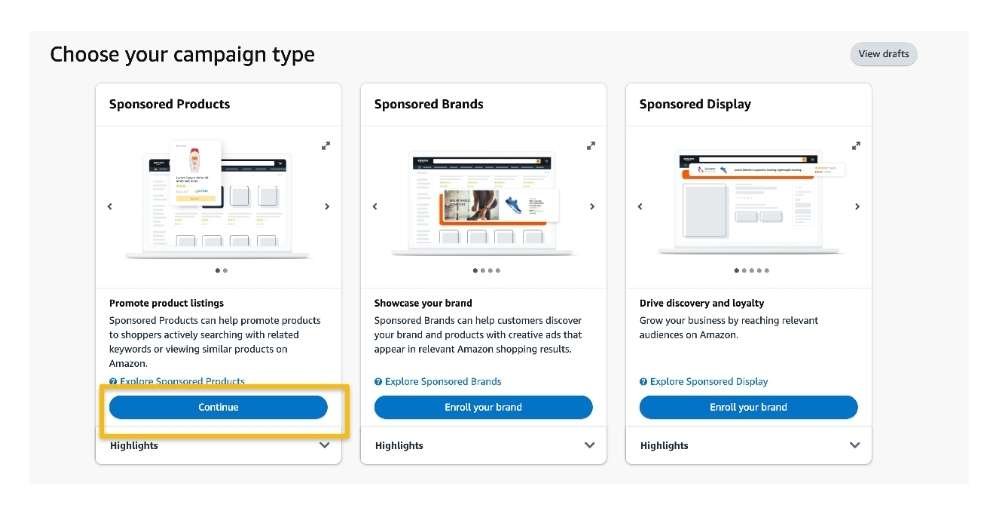
Once you have logged into your Amazon Dashboard advertising dashboard, you will see a screen similar to the screen below where you will select “Sponsored Products” and continue further:
Targeting Options in Sponsored Products
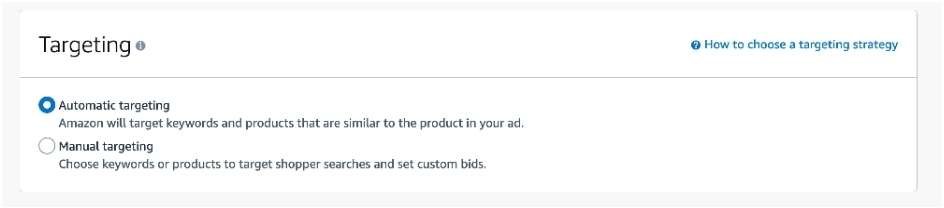
In setting up your Sponsored Product campaign, Amazon gives you two main targeting options:
- Automatic Targeting:
In this method, Amazon uses machine learning to automatically target your ads to relevant search terms and products. This is a great option if you’re new to Amazon Ads and do not have a lot of data or keyword insights. The platform makes data-driven decisions for you, leading to a simpler ad setup process.
- Manual Targeting:
This option gives you more control over where your ads appear. You can choose the keywords or products that you want your ads to target. This requires a bit more work and keyword research, but it gives you the power to fine-tune your campaigns and target more specific audiences.
Should you choose automatic targeting or manual targeting?
If you have a considerable budget and in the “Discovery” phase of your marketing where you are trying to figure out which relevant product titles or keywords work the best, then Automatic Targeting can be a great starting point. By consistently adding “negative” keywords you can fine-tune the performance of your automatic targeting campaigns. Keep in mind Automatic targeting campaigns can be considerably more expensive in the short run and deliver a sub-par ROI compared to Manual targeting campaigns.
However, if you already have some data and insights about the keywords or product titles that work the best for your book, then Manual Targeting would be the way to go to sell books on Amazon India. With Manual Targeting, you can select the keywords or products you want to target, set your own bid and budget, and have more control over your ad spend.
Manual Targeting – Keyword Targeting Explained
If you select manual targeting, you get two options. You can either target by:
- Keywords
- Products
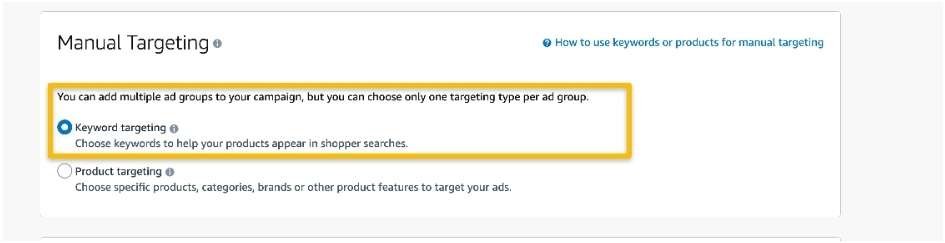
Selecting the right keywords is crucial to the success of your campaign. Start with identifying the keywords your potential readers are most likely to use while searching for books in your genre. For example, if you have written a book around psychology and self help. You should not only bid on self help related keywords, but on various other psychology terms as well such as “cognitive psychology”, “behavioral psychology”, “positive psychology” etc (if your book contains these topics).
Ideally, you should start with 30-50 keywords in your campaign (no more), test the results from the keywords and optimize your campaign going forward.
If you are not sure about how to market your book, check out Ayush Pant’s post on ‘Online Book Marketing – The Ultimate Guide for Authors in India’.
Your keywords list should be something like this (if targeting a self help / psychology book):
- cognitive psychology
- self help
- positive psychology
- mindfulness
- behavioural psychology
- emotional intelligence
- personal growth
- personal development
- mental wellness
- life coaching
There are various tools available for keyword research also. Feel free to start out with free keyword tools such as Google Ads “Keyword Planner”, Ubersuggest keyword tool. Then there are some paid keyword tool options as well such as “AMZ Scout”. I do not recommend going for paid keyword research tool because Google Ads tool is quite comprehensive in itself (Note: you will need a Google Ads account to use the keyword research tool).
Ideally, you should begin your keyword research first with your own subject matter expertise, and use keyword research tools to expand on your core ideas. I use the keyword research tool to estimate the search traffic (number of searches a keyword gets) so that I can prioritise the keywords for my campaigns and to expand on the core list.
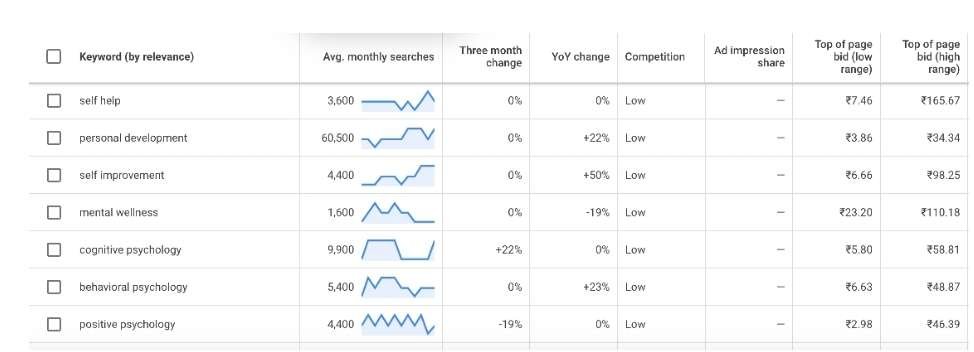
One cannot stress enough that keyword research is the most important phase of your campaign planning. If you do this right, the chances of your campaign success are very high (assuming your book is relevant to the targeted keywords)
After you have selected the keywords, it’s time to talk about keyword “match types” for your campaign.
Amazon Ads has three keyword match types available:
- Broad Match: This type of match displays your ad to a wide audience, including those who use synonyms, related searches, and variations of your keyword. For instance, if your keyword is “self-help”, Amazon might also show your ad to users searching for “personal growth” or “wellness books”.
- Phrase Match: This match type triggers your ad when users search for your exact keyword or close variants. It’s more precise than broad match but less restrictive than exact match. For instance, if your keyword is “self-help”, your ad might appear for “self-help books” or “best self-help books.”
- Exact Match: This is the most specific match type. Your ad will only show up when users search for your exact keyword or very close variations. For instance, if your keyword is “self-help”, your ad will only appear for searches like “self-help” or “self help”. This match type allows you to target a very specific audience, but it may limit the reach of your ad.
Which keyword match type should you use for your campaign?
The keyword match type you choose largely depends on your campaign goals and how broad or specific you want your target audience to be.
- If you’re in the discovery phase of your campaign, and want to attract a broad spectrum of potential readers, then you can go with Broad Match
- If you want to retain some control over what keywords your book title should appear for yet target a broader audience who may use a keyword you haven’t yet discovered, you can go with Phrase Match
- If you are confident about your keyword selection and want to target a very specific audience, then you should opt for Exact Match
Personally, I prefer to start off with an extensive keyword research and preparing a potential list of 50-100 keywords that I could target for in a campaign and use “Phrase Match” and “Exact Match” in my campaigns. I tend to shy away from broad matches because they can deplete your advertising budget fast and get your irrelevant clicks.
I recommend to use broad match only when 1) you have a significant advertising budget 2) you’re unsure of the full spectrum of keywords to use for your campaign.
Now that we have covered match types, it’s time to talk about “Bidding Strategies” for your ads to sell books on Amazon India.
Amazon offers three bidding options:
- Dynamic Bids – Down Only: Amazon will decrease your bid in real time when the ad may be less likely to convert.
- Dynamic Bids – Up and Down: Amazon will raise your bid (up to 100%) in real time when the ad may be more likely to convert and lower it when less likely.
- Fixed Bids: Amazon will use your exact bid and won’t make any changes based on likelihood of conversion.
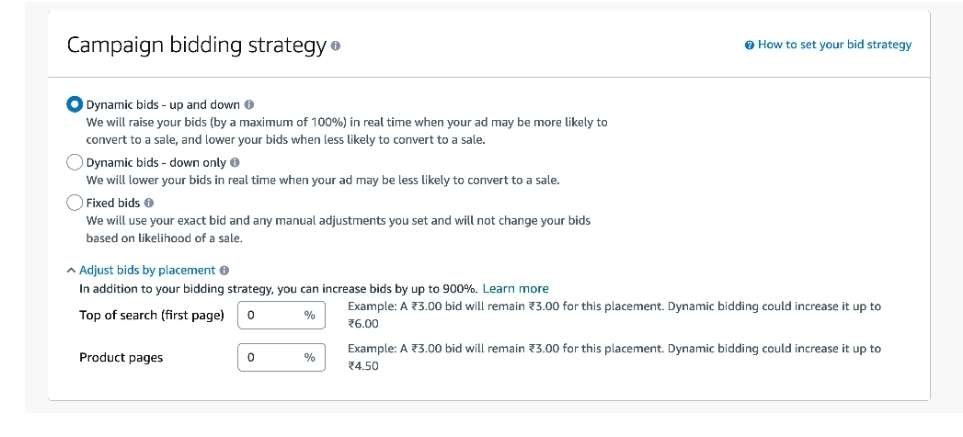
In addition, you can adjust bids by placement. For example, you could bid 20-25% higher for “Top of the search (first page)” and product pages.
How to choose the best bidding strategy?
In order to understand the best bidding strategy, it’s first important to consider few metrics such as “costs” and “ACOS” (Advertising Cost of Sale).
What is ACOS?
To explain in simple terms, ACOS is the percentage of direct sales you made from Amazon Ads compared to how much you spent on the ad.
Quick formula: ACoS = (Ad Spend / Sales Amount ) x 100%
For example, if you spent ₹5000 on ads and made ₹30000 in sales, your ACoS would be 16.66% (i.e., ( ₹5000 / ₹30000) * 100%).
Your ACOS will help you understand if your current bidding strategy is cost-effective or not. If your ACOS is too high, it might indicate that you’re spending too much on ads and not getting enough returns from sales.
Choosing the right bidding strategy takes a bit of experimentation. I’d recommend starting with “Dynamic Bids: Down Only” as this strategy will help you optimize your ads for profit.
However, if you have a strong understanding of your target audience and a higher budget, “Dynamic Bids: Up and Down” might be a better fit. This strategy allows Amazon to automatically increase your bid in scenarios where the ad is likely to convert, potentially leading to higher sales.
Now that we have covered bidding strategies. Let’s talk about Negative Keywords.
Here’s a list of ’13 Book Marketing Companies in India’ that can help you take your book to a wider audience.
What are Negative Keywords
To put it simply, negative keywords are the terms that you do not want your book to appear for. They are a crucial component of the strategy and help prevent irrelevant clicks and wasted ad spend on terms that are less likely to convert into sales.
In the example earlier, we shared an example of a self help / psychology books. Here are some terms that we may want to consider adding to our negative keywords list.
For instance:
- “Psychology textbooks”: Users searching for textbooks are likely looking for academic material, not a self-help book.
- “Children’s self-help books”: If your book is aimed at adults, you would not want your ads to appear for searches related to children’s books.
- “Free self-help books”: Users searching for free books are less likely to make a purchase.
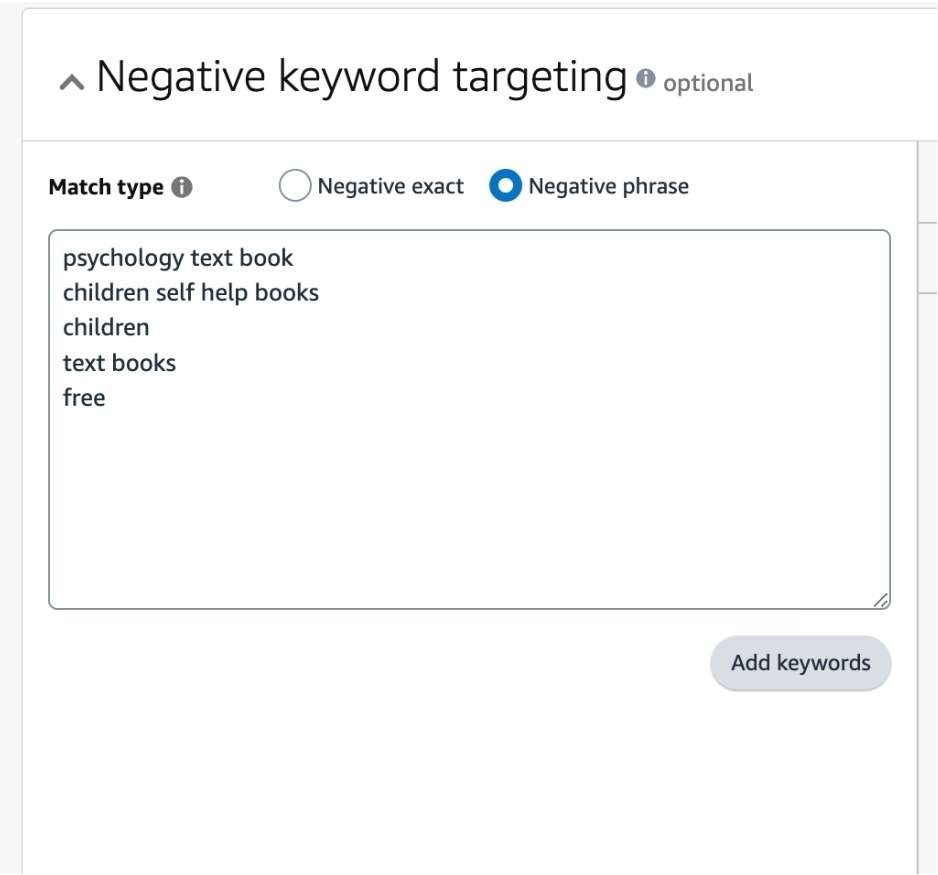
Pro tip: Add negative keywords as “negative phrase” and it will help you avoid all search queries that contain that phrase.
For example, by adding “free” as a negative phrase, you will not appear for any search that includes “free”, such as “free self-help books”, “free psychology books”, etc. This can further help you save your ad budget for the audience that is actually interested in purchasing your book.
Negative keyword lists can be created and managed within your Amazon Ads dashboard. As you monitor your campaign performance, make sure to continually update this list based on the search terms that are triggering your ads but not converting into sales.
Now that we have keyword targeting out of the way, let’s talk about Product Targeting on Amazon.
How to use Product Targeting in Amazon?
Product Targeting on Amazon is a strategy that lets you target individual products, categories or brands or product features that are similar to your book. This strategy is beneficial because it allows people to find “similar books” to people who are browsing products in the same genre or similar to your book.
For example a book in the self help / psychology genre may want to target the following categories and products.
- Categories: psychology, self help, personal development, mental health
- Products: “The Power of Now” by Eckhart Tolle, Dale Carnegie ‘s “How to Win Friends and Influence People”, “The Subtle Art of Not Giving a F*ck” by Mark Manson.
Product targeting can be a game-changer, especially if you know your target audience’s reading habits and preferences well. It can help you reach potential buyers who are already interested in similar products or categories, thus increasing your chances of conversions.
But, as with other strategies, it requires careful planning and continuous monitoring for best results. Start by choosing several related categories or products to target. Over time, you can adjust your targets based on the performance data you collect.
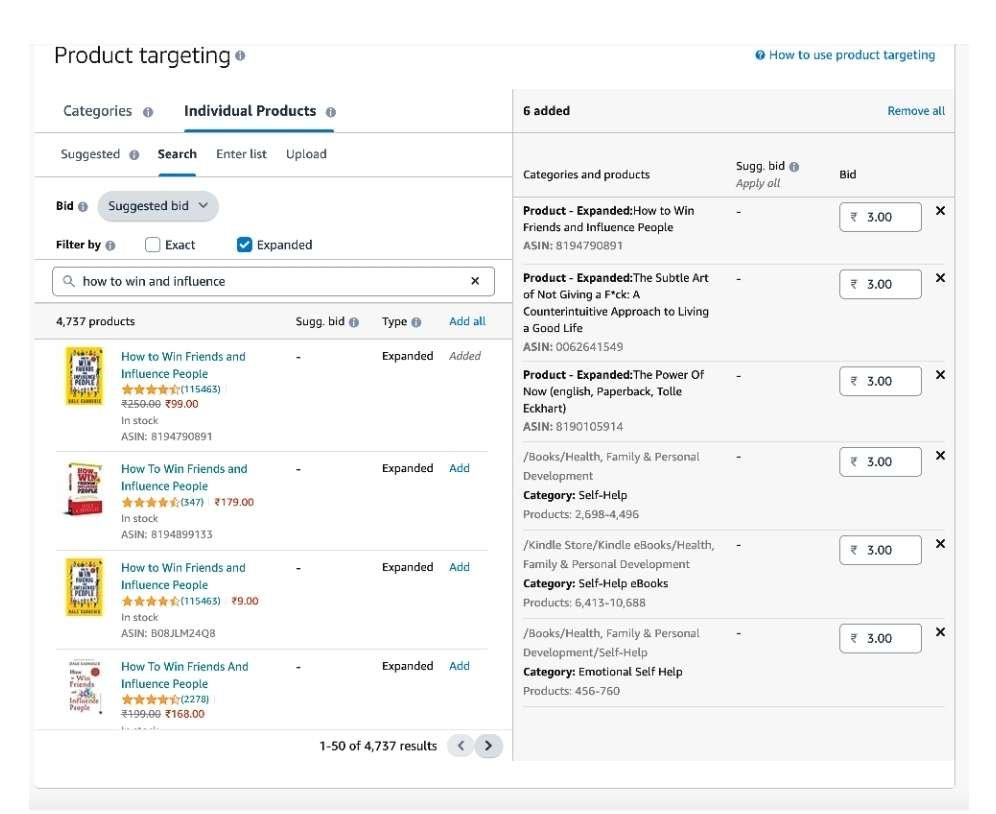
Keyword Targeting vs Product Targeting – Which Should You Choose?
Both Keyword Targeting and Product Targeting have their advantages and are useful in different circumstances.
Keyword Targeting allows you to target specific words or phrases related to your book. This is particularly useful if your book is in a popular or highly competitive category. By using specific keywords, you can reach potential readers who are searching for exactly what your book offers.
Product Targeting, on the other hand, allows you to target specific products or categories related to your book. This is especially beneficial if you’re selling a book in a niche category, or if you want to target readers who are already interested in similar books. By targeting specific products or categories, you can reach a well-defined audience who are already interested in your book’s genre or topic.
My recommendation is to try both. However, please be very thorough with your keywords and products / category research. You will need to invest time and perhaps some money in understanding what works best for your specific book and target audience.
And remember, what worked for one book may not work for another, so always be ready to modify and tweak your strategies based on your results.
Still need more information on self-publishing your book? Check out our guide on ‘Amazon or Self Publishing in India: 3 important options’.
Tracking and Optimising Your Amazon Ads Campaign
Now that you have learned the fundamentals of “Sponsored Product” ads on Amazon it’s time to dive into tracking and optimizing your advertising campaign to sell books on Amazon India. One thing to note is optimization is an ongoing process and requires regular monitoring and adjustments for best results.
Before we talk about how to optimize, first you must learn where to view the performance data to make informed campaign decisions. The reports are available for you in the “Reports” tab. There are 6 main reports that Amazon offers.
- Targeting and Keyword Report: These reports provide insights into sales and performance metrics for targets in all campaigns
- Keyword Placement Report: The keyword placement report breaks out keyword performance by ad placement (top of search, other placements).
- Campaign Report: The campaign report summarizes your ads’ performance by campaign for a selected date range.
- Campaign Placement Report: The campaign placement report breaks out campaign performance by ad placement (top of search, other placements).
- Advertised Product Report: Advertised product reports provide insights into sales and performance metrics for your advertised ASINs in all campaigns that received at least one impression.
- Search Term Report: Search term reports give visibility into the search terms entered by shoppers searching on Amazon. You can use this report to identify high performing searches from shoppers and to create negative keyword or product targets for search terms that don’t meet your goals.
Understanding metrics of your Amazon Ads Report:
- Impressions: The number of times your ad was viewed
- Clicks: The number of times your ad was clicked
- Click-through-rate (CTR): The percentage of times people saw your ad and clicked it
- Cost-per-click (CPC): The average amount you paid for each click on your ad
- Spend: The total amount you spent on the ad campaign
- Sales: The total revenue generated from your ad campaign
- Advertising cost of sales (ACOS): The percentage of ad spend that resulted in a sale
- Orders: The total number of orders that resulted from your ad campaign
Search terms report is one of the most important reports as it allows you to understand what shoppers are searching for, what keywords are triggering your ads, and which ones are actually leading to sales.
Based on these reports, you should continuously optimize your campaigns. Here are some tips on how to do that:
- Add negative keywords: Identify the keywords which are bringing you irrelevant traffic or not contributing positively to the campaign. Add the terms as negative terms
- Adjust bids: If you see that a keyword is underperforming. Then, there are a couple of actions you can take. 1) Pause the keyword 2) Lower the keyword bid.
At the end of the day , the success of your Amazon Ads campaign lies in how well you understand and respond to your data. Look at your campaign metrics regularly, identify trends and patterns, and adjust your strategy accordingly. Remember, it’s not about spending the most money, but about spending your budget wisely.
One Final Tip: Optimize Your Book’s Landing Page
Before we conclude, it’s important to touch on one last important aspect of your Amazon ads strategy to sell books on Amazon India: optimizing your book’s landing page. This is the page on Amazon where a potential reader ends up after clicking your ad.
Having an A+ Amazon page can significantly improve your sales conversion rate.
Amazon A+ content allows you to enhance your product story with visuals and text. It can help you to differentiate your book from the competitors, showcase your book’s unique features, and provide additional information and insights about your book.
Here are some tips to create a compelling A+ content for your book’s page:
- Use high-quality images: Using high quality images on your book can make it more appealing and professional
- Include detailed product descriptions: Include prominent reviews if you can on this section
- Add customer testimonials: Don’t forget to include / highlight l readers feedback about your book
- Highlight unique features: Showcase your book’s uniqueness in the book description
- Add Videos : If possible, you can add video trailer as well in the book’s images. (make sure the trailer is high quality).
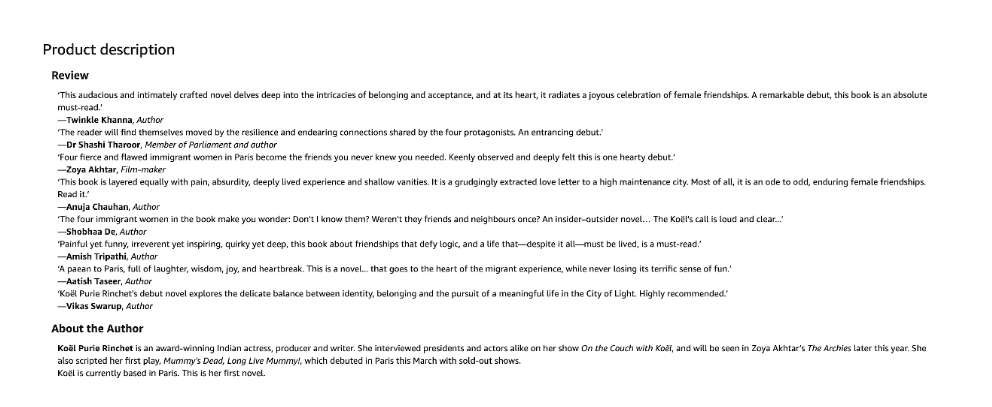
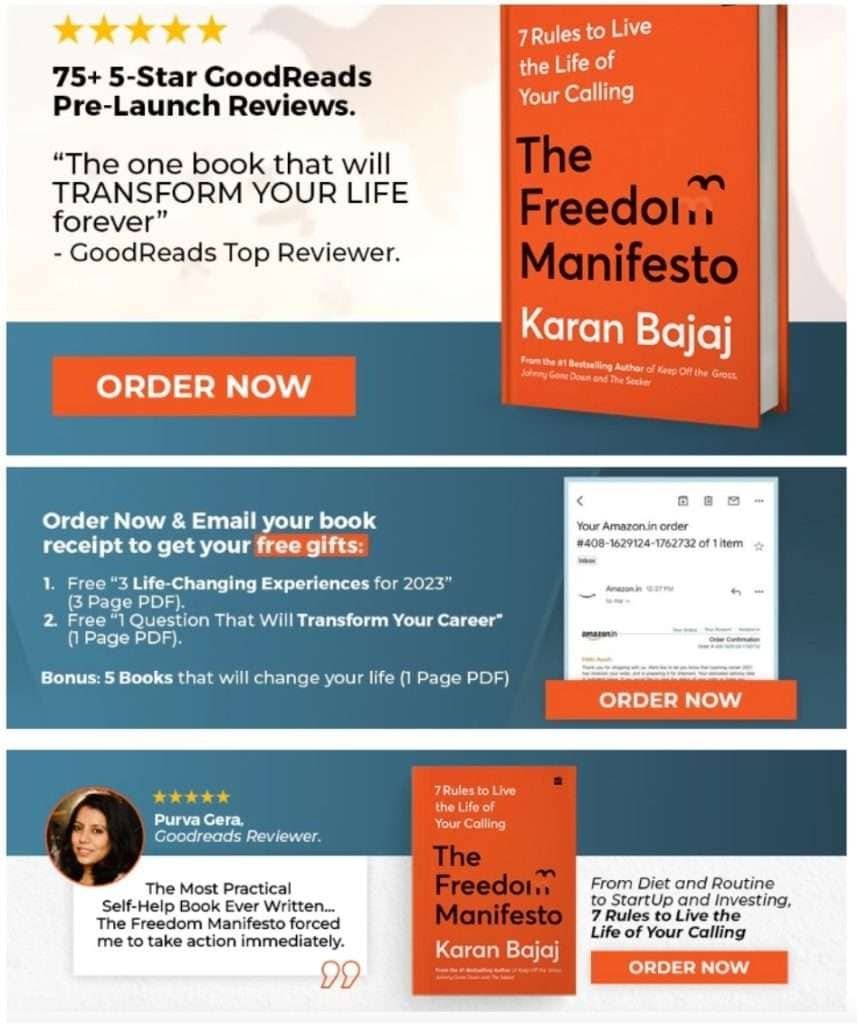
Effective Amazon Ads campaign management involves continuous monitoring, optimization, and creativity. Always ensure your book’s landing page is as persuasive and professional as possible to convert ad clicks into purchases. As an author, remember that your journey to success on Amazon is a marathon, not a sprint. Keep refining your strategy, learn from your trials and errors, and never stop exploring new opportunities for your book’s visibility and sales.
Closing Thoughts
An Amazon campaign should run for a minimum of 2 weeks before you can begin to evaluate its performance. This is because it takes time for data to accumulate and provide a clear picture of your campaign’s success or areas of improvement. Regular updates and adjustments, based on the Amazon Ads reports, are vital in ensuring the best possible outcomes.
If your budget permits, then you can consider hiring qualified individuals or book marketing agencies who can manage your Amazon Ads campaigns professionally, which can help boost your book’s visibility and sales. These experts can help optimize your campaigns, create engaging ads, and analyze your ad performance data, freeing up your time to focus on other aspects of marketing such as PR and events.
In conclusion, using Amazon Ads for your book’s campaigns can be a very powerful tool for increasing visibility and to sell books on Amazon India driving sales. However, it requires careful attention to data analysis, strategic ad placement, and continuous optimization. The key to success is to be patient, to learn from your campaign performance, and to constantly fine-tune your approach. Investing time and effort into understanding how Amazon Ads work will not only increase your book sales, but it can also provide valuable insight into the behavior of your target readers.
Running out of shelf space at home? Make space & earn money by selling your old books to make space for new ones. Check out our guide to ‘How to sell used books on Amazon India?’