

Quick Jump

AI: What writers should (and shouldn’t) use it for

AI is out now, and there’s no way to unrelease that proverbial genie. Writer’s reactions to AI range from denial to an Osho-like orgasmic fervour.

Both are over-reactions.

Dear poet/writer, we'd love to know you better.
What are you writing?

Prose
Poetry
Both

In prose, you prefer...

Fiction
Non-fiction

To stay informed about articles related to poetry writing,
would you like to get emails from us?
We don't spam and you can unsubscribe any time.

    In prose, you prefer...

    Fiction
    Non-fiction

    To stay informed about articles related to fiction writing,
    would you like to get emails from us?
    And we're happy to throw in two free courses, too
    We don't spam and you can unsubscribe any time.

      To stay informed about articles related to prose and poetry writing,
      would you like to get emails from us?
      And we're happy to throw in two free courses, too
      We don't spam and you can unsubscribe any time.

        To stay informed about articles related to non-fiction writing,
        would you like to get emails from us?
        And we're happy to throw in two free courses, too
        We don't spam and you can unsubscribe any time.

          AI cannot be the writer, but it can help the writer. If you know what you’re trying to say, AI can help you craft it – especially for non-fiction. Like this email – yes we used AI for a Neanderthal first draft. Then we rewrote almost all of it. AI was a bouncing board that helped us figure out what we wanted to say.

          But if you let AI write, you get a formulaic rehash in Americanese that sounds like a machine wrote it. AI can, at best, be the editor. You’re always the writer.

          Ergo, the key question: Which parts of writing benefit from AI, and which stay human?

          Ameen Haque
          Click on the image to know more about the course and to apply!
          Arundhathi Subramaniam
          Click on the image to know more about the course and to apply!
          Jerry Pinto
          Click on the image to know more about the course and to apply!
          Kanishka Rahul
          Click on the image to know more about the course and to apply!
          Kritika Pandey
          Click on the image to know more about the course and to apply!
          Ranjit Hoskote
          Click on the image to know more about the course and to apply!
          Debdatta Dasgupta
          Click on the image to know more about the course and to apply!

          AI can do a lot of basic hygiene stuff. It can tighten and streamline sentences ( it may improve clarity, but not beauty), rewrite emails, cut repetition, enforce brevity for overwriters, and polish and perk up slack prose. If you’re not looking for originality but for smart sounding rewriting, it’ll do (ergo, all the assembly-line blogposts suffering from clonespeak.)

          But ask it for, say, an original metaphor, and you’ll likely get trash. A metaphor describing todays digital generation like “I dont think that stillness, that quality of attention, is even possible in digital-age humans, who suckle on mobile phones from the day they are born.” needs a human who connects dots in a unique way in their head. This example is from Page 328 of Arundhathi Roy’s “Mother Mary comes to me”.

          But at the structural level, does AI help improve flow, probe, reorganize like a master editor – think Tay Hohoff or Ravi Singh? Nah. AI has no aesthetic. Of course, with smart prompting, you can tell it which aesthetic to imitate. But when people have tried to write fiction, it comes off as smart but familiar sounding. Clever language that leaves you wondering exactly what it’s saying. Like this much touted piece that Sam Altman mentioned HERE.
          ​
          AI is useful for research too: AI surfaces quick directions for topics like science or history. It can even make decent thematic suggestions for fiction, especially genre fiction. Devdutt Pattanaik, who teaches for us, told us how he uses AI extensively as a tool for research.
          ​
          When he was at the retreat last October he recorded and transcribed all his own sessions – so AI was his virtual assistant, not his co-writer. It helped him do more with what he already knew.

          Ameen Haque
          Click on the image to know more about the course and to apply!
          Arundhathi Subramaniam
          Click on the image to know more about the course and to apply!
          Jerry Pinto
          Click on the image to know more about the course and to apply!
          Kanishka Rahul
          Click on the image to know more about the course and to apply!
          Kritika Pandey
          Click on the image to know more about the course and to apply!
          Ranjit Hoskote
          Click on the image to know more about the course and to apply!
          Debdatta Dasgupta
          Click on the image to know more about the course and to apply!

          But he doesn’t use AI to actually write. That he keeps for himself.

          In his three city AI workshop tour, Chetan (who leads this himalayan workshop) called AI an imbalanced brain, with a overdeveloped left half, and a puny right too small for humanness.

          Human_vs_AI_Brain

          So you can use AI to evaluate rational options, process data, following grammar rules etc. But you, dear writer, have bring in the human elements like uncertainty, taste, and aesthetic. AI cannot be trusted with those. Tools create options and may accelerate arrival, but only you can decide what’s worth saying, and how to say it so it connects.

          AI is out now, and there’s no way to unrelease that proverbial genie. Writer’s reactions to AI range from denial to an Osho-like orgasmic fervour.

          Both are over-reactions.

          Dear poet/writer, we'd love to know you better.
          What are you writing?

          Prose
          Poetry
          Both

          In prose, you prefer...

          Fiction
          Non-fiction

          To stay informed about articles related to poetry writing,
          would you like to get emails from us?
          We don't spam and you can unsubscribe any time.

            In prose, you prefer...

            Fiction
            Non-fiction

            To stay informed about articles related to fiction writing,
            would you like to get emails from us?
            And we're happy to throw in two free courses, too
            We don't spam and you can unsubscribe any time.

              To stay informed about articles related to prose and poetry writing,
              would you like to get emails from us?
              And we're happy to throw in two free courses, too
              We don't spam and you can unsubscribe any time.

                To stay informed about articles related to non-fiction writing,
                would you like to get emails from us?
                And we're happy to throw in two free courses, too
                We don't spam and you can unsubscribe any time.

                  AI cannot be the writer, but it can help the writer. If you know what you’re trying to say, AI can help you craft it – especially for non-fiction. Like this email – yes we used AI for a Neanderthal first draft. Then we rewrote almost all of it. AI was a bouncing board that helped us figure out what we wanted to say.

                  But if you let AI write, you get a formulaic rehash in Americanese that sounds like a machine wrote it. AI can, at best, be the editor. You’re always the writer.

                  Ergo, the key question: Which parts of writing benefit from AI, and which stay human?

                  Ameen Haque
                  Click on the image to know more about the course and to apply!
                  Arundhathi Subramaniam
                  Click on the image to know more about the course and to apply!
                  Jerry Pinto
                  Click on the image to know more about the course and to apply!
                  Kanishka Rahul
                  Click on the image to know more about the course and to apply!
                  Kritika Pandey
                  Click on the image to know more about the course and to apply!
                  Ranjit Hoskote
                  Click on the image to know more about the course and to apply!
                  Debdatta Dasgupta
                  Click on the image to know more about the course and to apply!

                  AI can do a lot of basic hygiene stuff. It can tighten and streamline sentences ( it may improve clarity, but not beauty), rewrite emails, cut repetition, enforce brevity for overwriters, and polish and perk up slack prose. If you’re not looking for originality but for smart sounding rewriting, it’ll do (ergo, all the assembly-line blogposts suffering from clonespeak.)

                  But ask it for, say, an original metaphor, and you’ll likely get trash. A metaphor describing todays digital generation like “I dont think that stillness, that quality of attention, is even possible in digital-age humans, who suckle on mobile phones from the day they are born.” needs a human who connects dots in a unique way in their head. This example is from Page 328 of Arundhathi Roy’s “Mother Mary comes to me”.

                  But at the structural level, does AI help improve flow, probe, reorganize like a master editor – think Tay Hohoff or Ravi Singh? Nah. AI has no aesthetic. Of course, with smart prompting, you can tell it which aesthetic to imitate. But when people have tried to write fiction, it comes off as smart but familiar sounding. Clever language that leaves you wondering exactly what it’s saying. Like this much touted piece that Sam Altman mentioned HERE.
                  ​
                  AI is useful for research too: AI surfaces quick directions for topics like science or history. It can even make decent thematic suggestions for fiction, especially genre fiction. Devdutt Pattanaik, who teaches for us, told us how he uses AI extensively as a tool for research.
                  ​
                  When he was at the retreat last October he recorded and transcribed all his own sessions – so AI was his virtual assistant, not his co-writer. It helped him do more with what he already knew.

                  Ameen Haque
                  Click on the image to know more about the course and to apply!
                  Arundhathi Subramaniam
                  Click on the image to know more about the course and to apply!
                  Jerry Pinto
                  Click on the image to know more about the course and to apply!
                  Kanishka Rahul
                  Click on the image to know more about the course and to apply!
                  Kritika Pandey
                  Click on the image to know more about the course and to apply!
                  Ranjit Hoskote
                  Click on the image to know more about the course and to apply!
                  Debdatta Dasgupta
                  Click on the image to know more about the course and to apply!

                  But he doesn’t use AI to actually write. That he keeps for himself.

                  In his three city AI workshop tour, Chetan (who leads this himalayan workshop) called AI an imbalanced brain, with a overdeveloped left half, and a puny right too small for humanness.
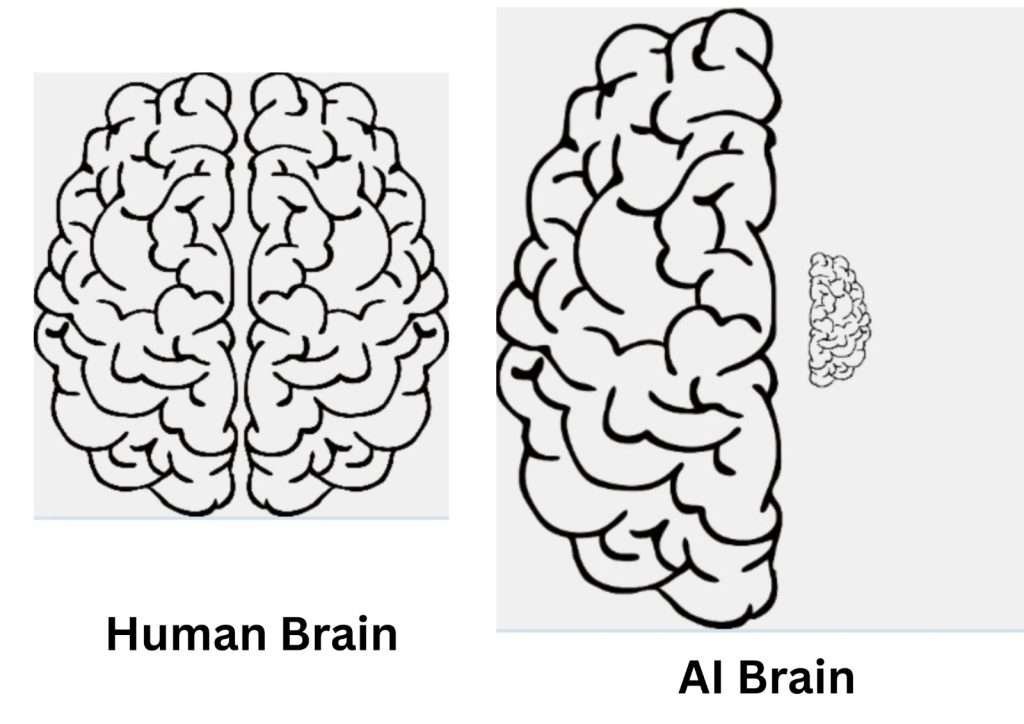
                  Human_vs_AI_Brain

                  So you can use AI to evaluate rational options, process data, following grammar rules etc. But you, dear writer, have bring in the human elements like uncertainty, taste, and aesthetic. AI cannot be trusted with those. Tools create options and may accelerate arrival, but only you can decide what’s worth saying, and how to say it so it connects.

                  2 Responses

                  1. AI replies to the questions posed . I wonder what kind of analysis and research does it undertake .
                    Suppose , I pose a question that Bhumra should have been the MOM , in the recently concluded T-20 in the game against England and not NewZealand , it will reel some stats . Recently a former English cricketer was candid to state that SA was a stupid team , by not losing to WI , which would have eliminated India from the championship. What kind of reply would AI provide ?

                  Leave a Reply

                  Your email address will not be published. Required fields are marked *

                  This site uses Akismet to reduce spam. Learn how your comment data is processed.




