



Our new friends closed the door behind them. We listened to their fading chatter as they meandered down the path that would connect them to the system of trails winding through and around the Satkhol hills. They were off to visit a Hindu temple near one of the trails. I imagined something small and intimate, visited primarily by those practising Hindus who lived nearby.
Dear poet/writer, we’d love to know you better.
What are you writing?
In prose, you prefer…
To stay informed about articles related to poetry writing,
would you like to get emails from us?
We don’t spam and you can unsubscribe any time.
In prose, you prefer…
To stay informed about articles related to fiction writing,
would you like to get emails from us?
And we’re happy to throw in two free courses, too
We don’t spam and you can unsubscribe any time.
To stay informed about articles related to prose and poetry writing,
would you like to get emails from us?
And we’re happy to throw in two free courses, too
We don’t spam and you can unsubscribe any time.
To stay informed about articles related to non-fiction writing,
would you like to get emails from us?
And we’re happy to throw in two free courses, too
We don’t spam and you can unsubscribe any time.
And soon, the temple would also be visited by a collection of Americans who’d gathered for 10 days at the Himalayan Writers Retreat (HWR) to work on their creative projects—traditional novels, graphic novels, films, essays, stories.
But not me. And not Mitch. And not Elizabeth. Instead, the three of us decided to hang out back at the retreat centre and write.
Mitch, Elizabeth, and I—and most of the others on the retreat—were invited to apply for HWR by Kathleen Rooney, the instructor leading the retreat. She figured that, if she were going to teach writing in this northern Indian village, it’d be fun to do so with friends and former students.
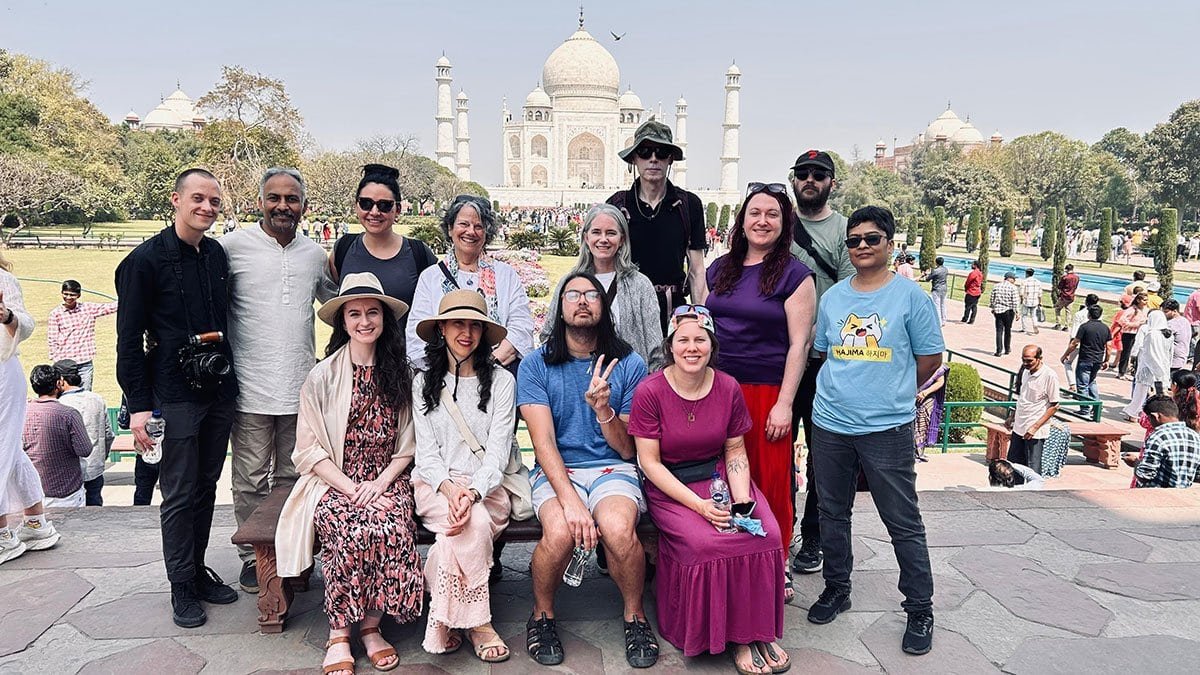
The theory was a sound one, especially because every day of the retreat, we toured something amazing, something made even more amazing when experienced with our peers: the Taj Mahal, where we learned about Shah Jahan, who constructed the mausoleum to serve as a tomb for his favorite wife. A sprawling Hindu temple, where we received individual blessings from a priest and a smudge of vermilion on our foreheads. Old Delhi, where we rode in pedicabs, visited the world’s largest spice market, and sipped chai from a stall cut into the side of a concrete wall down a narrow alley. A local school, where we toured the grounds and met some of the students and teachers.
In the midst of it all, we learned about haibun, various methods of characterisation, POV, voice, and more.
And we learned about each other. We danced together and contributed to a playlist that still lives in my Spotify account. The playlist is called The Comma Up Party (I’ve forgotten why) and includes 76 songs. My favourite (which I’ll never forget) is “MÁQUINA CULONA” by Ralphie Choo and Mura Masa. (I just translated the song title for the first time and am cackling … I’ll let you translate it from the Spanish yourself if you’re so inclined). We set our alarms for 15 minutes before sunrise and met in the gathering spot outside where we ate breakfast every morning. We padded out in our pyjamas and draped blankets around our shoulders; we poured some sparkling wine (we never did figure out how on Chatan, who runs HWR, found any sparkling wine), and we toasted the sun as it rose over the Himalayan Mountains. We shared secrets, meals, naps and rooms. Our roommates became our person, a stranger-turned-confidant. When we checked out 10 days later, those strangers had become our family; we said not “Goodbye” but “Until next time.”
And then, after all that bustle and beauty, when the HWR added an impromptu excursion to a small temple a short hike away from the retreat centre, I didn’t go.
I wanted to. A teeny, very small part of me still wishes I had.
And also: I’m glad I skipped it. As Mitch put it, “I was in India to write. I needed those hours to write and improve my project.”
And I needed those hours to start my project.







+++
As part of each day’s writing lessons, we completed prompts. I wrote poems about characters who would appear in my yet-to-be-started novel, I journaled about POV, and I tested out various character and narrative voices. I wrote scenes to illustrate character details: how they’d respond to failure, how their history informed their reactions to the events of the novel. These scenes weren’t intended to be included in the book (though at least one of mine has made the cut so far) but instead help us understand our characters’ interiority and motivation.
After so much practice and consideration, after spending so much time meeting my main character—whose name is Mona, how do you do—I was beyond itchy to get writing. And I wanted, desperately, to write the first pages of the novel there, in the cosy room with the wood-burning stove and the zig-zag bookshelves. I wanted to write those pages there, with my new friends I suspected might someday become my old friends.
So I skipped that hike to the small, so-off-the-beaten-path-it’s-more-like-you-left-the-beaten-path-twenty-minutes-ago-to-find-yourself-on-the-side-of-a-mountain-and-now-you’re-wondering-if-you’ll-accidentally-stumble-on-any-animals temple to write with Mitch and Elizabeth.
What I wrote became the first chapter of a book I’m currently calling Little Ghost. I have almost a sensory memory of the experience of writing at that enormous table. Mitch told me the same thing.
“There was that calm but propulsive energy of people at work,” he said. “There were the sounds of typing and the inaudible sounds of thought. There were windows opening onto the retreat centre on all sides, which gave a mental sense of expansion, a limitlessness that is so critical to writing.”
It was an atmosphere that supported—that nearly begged for—creation. I didn’t have a sense of finding the story or the words, or even of working, particularly hard. Because, yes, writing is hard work. But sometimes, it’s not. Sometimes, like that instance with Mitch and Elizabeth, writing is a flow. Instead of fighting for every word, every punctuation mark, I experienced the type of writing where you touch your fingers to the keyboard, and the story pours out. The type of writing where the writer’s a mere conduit, and at the end, she reads over what she wrote with something just this side of wonder. “How did I do that? Was it really me?”
Because in that flow state, your brain seems to flicker off or go on standby. She’s there if you need her, around to help you find the right word when you trip or a good metaphor when you stumble. But your brain’s in chill mode. She’s on a beach somewhere with a mojito, and the surf lulls her into a happy stupor.
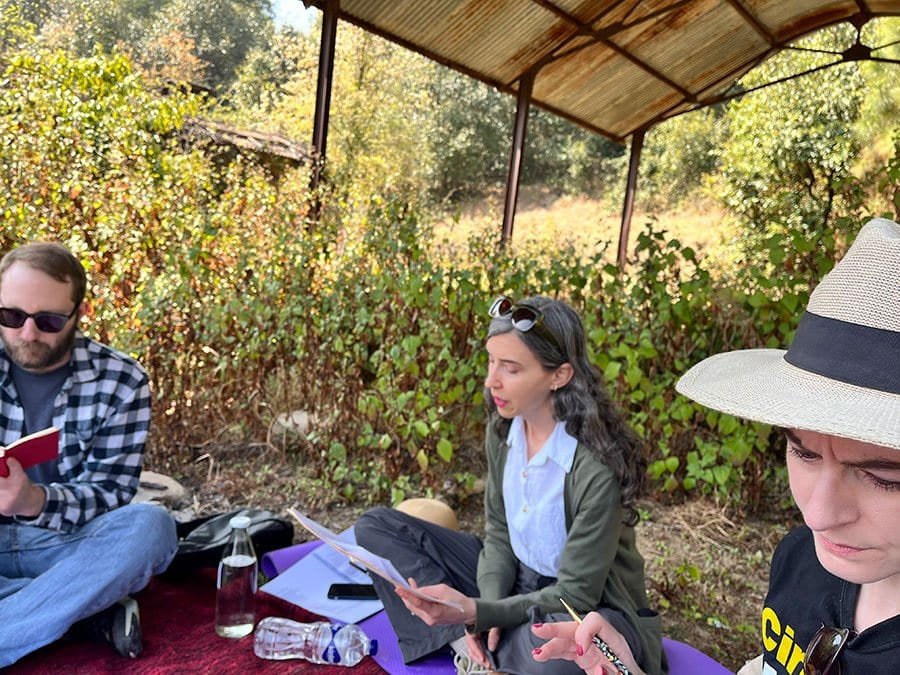
When you’re writing a first draft, you want to spend as much time as you possibly can in that flow state. It’s not always possible. You can’t really force it, and sometimes the only way you get through writing your scenes and chapters is by forcing yourself to the page and wrestling something out. And yes, you can absolutely write a whole book that way. Often, you have to.
But there’s something to be said about prioritising the work when you can, which is one way to encourage the flow state. When I say “prioritising the work,” I don’t necessarily mean going to India and making a bunch of new bffs (though, seriously, that works ridiculously well) but creating the space and setting to encourage that kind of creation.
During my time in India, yes, I participated in sessions and classes. I hiked with others and alone. I ate incredible food and saw jaw-dropping natural and ancient wonders. But I also took the time to say “no” to an incredible experience so I could hole up with a couple of friends and do the work.
+++
I just pulled up the document I created at the huge table in the HWR gathering room. It came into being at 8:41:59 a.m. Saturday, March 23, 2024. It’s four pages long, 1,071 words.
Today, as I type this blog post for HWR, Little Ghost is with readers. At the end of the month, I’ll hop on Zoom with two of them (and just corner my husband, because he’s my third reader) to get their thoughts and ideas, to hear what didn’t work, to learn what confused or bored them.
Since that first draft, Little Ghost’s first chapter has grown a bit, to five pages and 1,447 words. But the novel is clearly, completely, and absolutely a descendant of what I came up with in India—and it’s a descendant who looks an awful lot like her sire.
Because Chapter 1 isn’t the only piece that came from my time at HWR. During one of our workshops, Kathleen prompted us to write something about a failed trip, a time when a character sets out with a goal in mind, but something gets in the way.
I didn’t write a chapter so much as notes for a scene, where a young mother has plans for her son’s birthday, and those plans are completely derailed by two candles—a 1 and a 0. I didn’t know this scene was going to exist in Little Ghost; without Kathleen’s prompt, I suspect it wouldn’t exist at all.
HWR continued to permeate Little Ghost as I worked on it post-India, and I returned to the retreat center as I wrote, borrowing names and character traits from my new friends. I named a regular at the bar where Mona works “Pam.” Mona’s boss became “Ankush.” “Kaitlin” became a girl Mona used to babysit for.
Sure, those characters changed in subsequent drafts: One got deleted. Another got upgraded to a love interest. A third, I accidentally killed off. Regardless of the changes, those details are important for all a novel’s iterations and drafts. Every step in the process of writing a novel—a beast of a task, truly—is vital.
+++
On the final day of the retreat, we all read aloud something we’d written during our time at HWR. We heard poems, scenes, songs. Me? I shared that chapter.
It’s a nerve-wracking thing, reading the first draft of an entire chapter to a roomful of writers you admire, especially when you only started writing the novel a day or two ago. If it sucks, obviously you go back to the drawing board. Give it another go. Change what bored, what stalled, what stunk.
“I want to see if the ending of this chapter works,” I prefaced my read, “if it does what I intended it to do.” The chapter ended on something sort of big. Something incredibly big. And if the event fell flat, that was a deeply important thing to know.
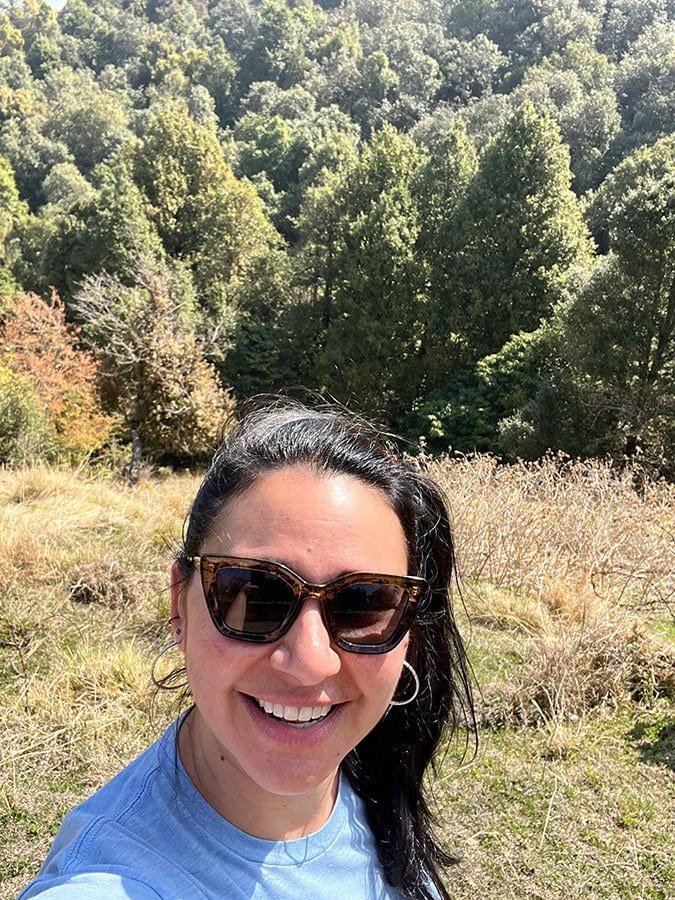
As I read, my new friends were quiet. I swear, even the bugs settled down to listen; I don’t remember buzzes or sighs, coughs or rustles. As a storyteller, it is a phenomenally cool feeling to have folks invested in what you read. It’s a little awkward, too; I don’t love to have people look at me. But to have them listen to you, to really consider what you’ve written? What a beautiful, special experience.
I read the last lines, and I geared up for … what, I don’t know. For boredom? Or a whole lot of “Meh”?
Instead, all I remember are little gasps around the room.
I paused. No one said anything. “I guess the ending worked?” I asked.
“I totally forgot you mentioned that,” someone said.
So I say this with absolutely no hyperbole: If I hadn’t spent 10 days at the HWR in March of 2024, the novel I have would not exist.