



“Please do vote for my sons / sisters / spouses book, (book title). It is an inspiring book nominated for XYZ prize. (Link to vote). Thank you so much!”
Sounds familiar? Mostly you ignore these, but sometimes you vote, right? So do you actually read the piece before you vote?
We ran a poll on LinkedIn and 32% people said they never read the book they’re voting for. Another 21% said rarely.
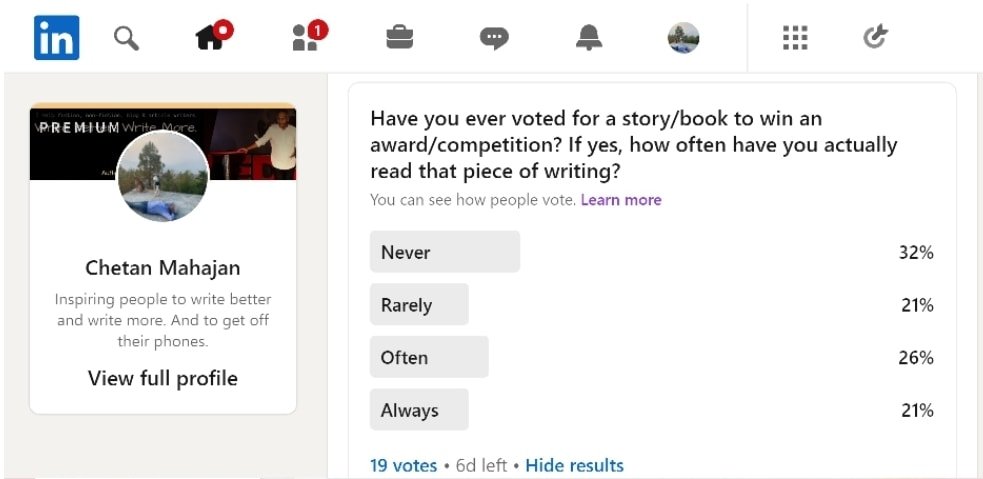
This is like voting for a candidate you know nothing about. In political elections we are fed information about the candidate. In a writing contest we mostly vote because we feel like we “owe it to somebody”.
Writing contest voters say to themselves “What do I have to lose? It’s just a vote in some contest.”
Other’s may think “I’ll vote for her. I need a favour from her too.” Yet other’s may say “If I don’t vote, XYZ will be upset with me.”
Few read the book. We don’t care about the work being good or bad. We care about our relationship with the person making the request – a spokesperson for the writer, or the writer themselves.
Our reason for voting is social, not literary.
Voting in any such award is about being nice, not being honest.
“What’s the harm?” you ask casually.
Let us take two hypothetical contest participants: Writey and Pushy.
Writey is an avid reader who works hard at the craft of writing, and submits her well-written story to a vote-based contest. Writey has ten close friends and family members who broadcast requests asking for votes.
Pushy doesn’t read, doesn’t want to learn the craft, and puts a tacky first draft in the same contest. But Pushy runs a campaign, and has fifty people pushing her submission.
Pushy wins. Pushy struts around, and actually starts to think she is a writer. Writey, on the other hand, is crushed. Full of self-doubt, she starts to think she is a terrible writer. She writes less. Maybe stops writing altogether.
Pushy, on the other hand, foists sub-par garbage onto the world. We then sit in our drawing rooms, and politely comment on how literature in India is going downhill.
No harm done, right?
Vote-based awards are a measure of pushiness, not talent.
We’ve seen too many such popularity contests being run purely to make money. Charging a hefty participation fee, and offering winners a “bundle” with a few intangibles like coverage in obscure podcasts / e-magazines is a profitable formula. All it needs is a few gullible writers hungry to recognition.
One contest we saw had an entry fee of INR 1499. The prizes (in INR) were:
1st prize: 2000
2nd prize: 1500, and
3rd prize: 1000.
With some virtual chillar thrown in.
The organizer also milks the writers in other ways.
Firstly, these organizers are skimping on any really meaningful feedback. The hardest part of any contest is judging. We run the HWR Flash Fiction contest and we found it hard to get credible people to judge our contest. It is a lot of reading and work. For our Flash Fiction contest we had 400 stories. At an average of 1250 words, that is almost 5,00,000 words to read. Three judges then read the shortlisted stories, and select the winners and the honorable mentions. All these winners got real prizes.
For the unethical organizer, the easy way out is to push that monkey also onto the participant’s shoulder. The contest organizer now has to do no work for judging the contest. They also have zero responsibility for the outcome.
Secondly, some organizers also push for Social media mentions. Writers are actually paying them to shout the organizers name out on social media. What could be better?
There are a few more credible ones which seem to be working to ensure a balance between votes and other measurable tactics. In some of these awards, the same person can cast the vote more than once after a time gap – that also means those with a larger budget can simply spend their way into winning.
So next time you see a writing contest judged by voting, look deeper. To learn more about how to evaluate contests, check back for our soon to be published blog post “seven steps to choosing the right contest”.
2 Responses
Sound advice. I got sucked into one like this in my initial days of writing. Not good! Thanks for putting this up.
You are welcome Firdaus. Keep writing!