



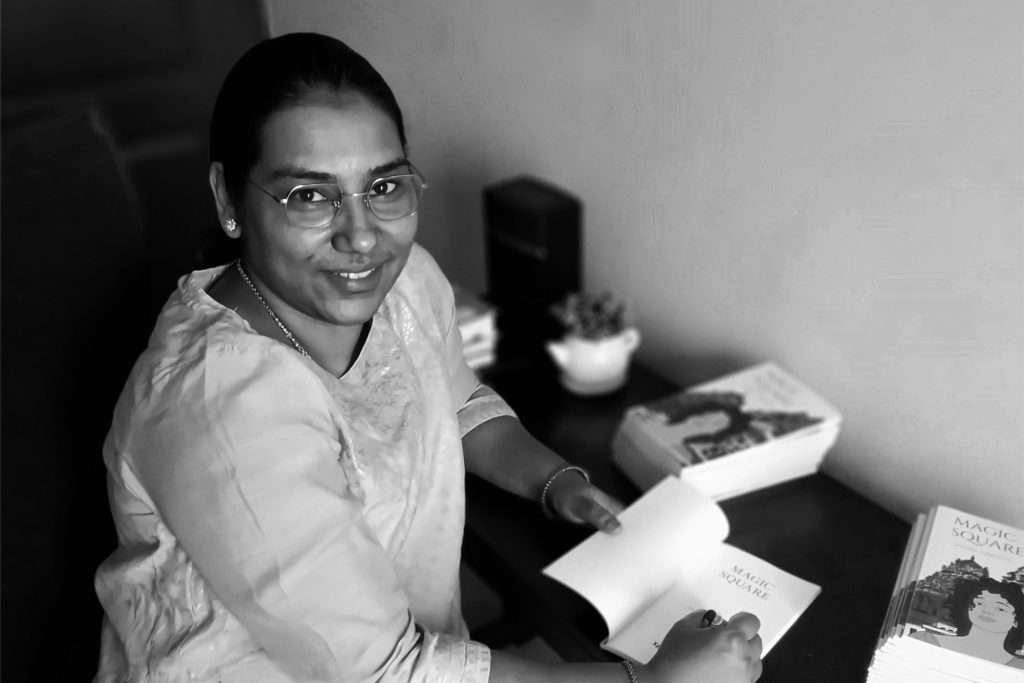
Salini Vineeth is a fiction and freelance writer based in Bangalore. She worked for ten years as an engineer before turning to full-time writing in December 2018. Since then, she has published five books – Lost Edges (novel), Magic Square (novella), Everyday People (a short story collection), and travel guides for Hampi and Badami.
Dear poet/writer, we’d love to know you better.
What are you writing?
In prose, you prefer…
To stay informed about articles related to poetry writing,
would you like to get emails from us?
We don’t spam and you can unsubscribe any time.
In prose, you prefer…
To stay informed about articles related to fiction writing,
would you like to get emails from us?
And we’re happy to throw in two free courses, too
We don’t spam and you can unsubscribe any time.
To stay informed about articles related to prose and poetry writing,
would you like to get emails from us?
And we’re happy to throw in two free courses, too
We don’t spam and you can unsubscribe any time.
To stay informed about articles related to non-fiction writing,
would you like to get emails from us?
And we’re happy to throw in two free courses, too
We don’t spam and you can unsubscribe any time.
She won the Orange Flower Award for Humour in 2023. Her short story collection Everyday People was the finalist in the Amazon Pen2Publish contest 2019. She won the eShe short story contests in 2019 and 2020.
Her stories have appeared in magazines like The Bangalore Review, Borderless Journal, Cafe Dissensus, Kitaab International, and The Bombay Review.
- Website – https://salinivineeth.in/
- Facebook – https://www.facebook.com/salini.sasidharan.37
- Twitter – https://twitter.com/salini_vineeth
- Instagram – https://www.instagram.com/salini_vineeth/
1. How did you decide to write about this subject? What was the idea in your head when you first conceptualized Lost Edges?
I started writing Lost Edges in 2014 while I was working as an engineer. The story of these two characters, Ravi and Geetanjali, was initially conceptualized as a short story. It was written originally in Malayalam, my mother tongue. It’s about a millennial couple going through issues in their marriage. Some readers told me that there is a scope for a novel in this short story. So, I decided to write a story about this urban couple, who are the representatives of the millennial generation.
I wanted to portray the issues faced by people who live in metro cities and work in the corporate world. There are a lot of stories about exotic locations and significant conflicts like wars, but I feel every person has an intriguing story, and it’s worth telling the story of a couple whose life seems ordinary for an outsider. I wanted the book to discuss important issues that people of my generation go through, like depression, anxiety, gender inequality, lack of work-life balance, and job dissatisfaction. Through Ravi and Geetanjali, I wanted to show how deep our childhood experiences can influence us, the importance of mental health, and taking up therapy. This novel is partially set on the BITS Goa campus. I was a part of the first batch of students who graduated from BITS Goa. I don’t think I can do a better tribute to my beloved collage, a place that I cherish.
2. How long did it take you to write this book?
I started writing Lost Edges in November 2014. I finished the first draft during the 2014 NaNoWriMo, and then I kept the novel aside for two years since I wasn’t sure what to do with the first draft. I picked it up again in 2016 and started reading it. It was like reading a novel someone else had written. Then, I had to do a lot of work, making the plot solid, perfecting the dual timeline, and getting Ravi’s and Geetanjali’s narrative voices right. I did at least seven to eight complete revisions of the novel and then gave it to beta readers. It was around 2018 time. I also did a manuscript evaluation, and finally, when the book was almost ready, the pandemic struck. I waited for 2 years, but I kept polishing the novel. Finally, it was published in 2023, and it took me 9 years to complete this novel and bring it out in its current form.
3. Do you finalize your story before you start writing, or do you let your characters develop organically?
Lost Edges was my first experience writing a novel. I am primarily a short story writer, and this novel also started as a short story. So, when I started the novel, I didn’t do plotting or the three-act structure. I wrote the first draft, around 50k words, just in a month. But it was just a raw first draft, nowhere near the final plot structure. So, then, I let the novel develop organically. I had a rough idea about the things happening in the novel, but I didn’t do a plot outline or detailed scenes or anything. It kept expanding, and the novel grew into 1 lakh plus words. Later, I did a lot of editing to make the plot concrete and the narrative tight. The novel has two timelines, so I needed to intersperse these two timelines without making the readers bored. So, I started a rigorous editing process, bringing down the novel from one lakh plus words to a mere 67k words. Since I had a lot of material to work with, I chose to retain only the best of what I had written. I also took help from beta readers, who gave me a lot of useful feedback. I also did another thorough revision after my editor, Pankaj Giri, raised some issues about the character development and plot, especially the climax. So, over the nine years, I have done a lot of revisions and reworks on this novel. If I write another novel, I might go through the systematic way, where I will do the plotting first, then the scenes and everything, and then get into writing. I am not sure if that process will work for me, but I would like to try that out.
4. What does your editing process look like?
I love editing my work. For me, the first draft is the most difficult one. So, while doing the first draft, I try not to worry about anything. I don’t worry about getting things perfect in the first draft. I won’t even keep my spell check on while doing my first draft. So, the first draft often comes out as very raw, and I consider it as a pre-step to my writing. Then, I keep the first draft aside for a few days or a week. I will pick it up then and start adding more details to the first draft. I like to call it the layering of the story. The first draft is just a barebone structure, and during the subsequent drafts, I add flesh to this structure. I add more nuances, and I often write 1000 or 2000 words extra to my target word count. Then, in the editing step, I will go through the story and start cutting down. I would have written a lot in a particular scene. I pick and choose what is absolutely necessary and best for that scene. So, for me, writing a piece is a three-step process. First, I will write the raw draft, then elaborate it into a big draft, and start cutting it down again. I also read my work aloud to see if the words have a rhythm. So, for me, the editing is a long process; it can go anywhere from weeks to months for a particular short story.

5. What advice do you have for young writers who want to get published in literary magazines and participate in fiction writing contests?
When I started writing in English, I didn’t know much about the publishing world. I kept writing without worrying about when and where my work would be published. The first step to getting published is to write. When you start writing, you shouldn’t be worried about where the work will be published. Stress isn’t a good thing for creative writing. So, the first thing is to forget about publication and keep writing. After you have the initial draft, it should go through many revisions. If you have friends who read and write, give your work to them for beta reading. Don’t worry about what feedback you’ll get. As a writer, you should learn not to worry about what others will think of your work. You need to put your work outside.
Editing is another important part. If you’re sending your work to a literary magazine or a competition, it’s a good idea to get a professional editor. One of my stories, Nest, published in the Out Of Print magazine, was professionally edited and went through multiple revisions. So, editing is an important process. Another thing is rejections. As soon as you start sending out work, you will get a lot of rejections. You should learn to work through rejections as it’s a natural part of the writing life. You’re getting rejected because you’re submitting a lot. So, it’s a good sign. As a writer, you should also do market research. Every magazine has different styles, and they publish a certain kind of work. So research which magazines publish work like yours. You can’t send a humorous story to a fantasy magazine. Spend some time researching literary magazines and what they usually publish.
6. Tell us how you came to the decision to shift gears in your career and become a full-time writer?
I started writing at a very young age, maybe when I was 10 or 11 years old. In fact, I made my first income from writing when I was around 14 years old. I participated in an essay writing competition and won 5000 rupees as the first prize. Back in 2000, it was a good amount of money. Now, I feel that it was a foreshadowing of my writing career if we talk in the literature jargon. But I didn’t pursue a degree in writing. Instead, I went on and got an engineering degree from BITS Pilani. I worked for ten years in the electronics industry. But, unfortunately, my heart wasn’t completely in engineering. I couldn’t find a connection to engineering, and I feel it’s very important for a person to feel connected to their work. You need a reason to get up every morning and go to work; you need something to look forward to. Many of my colleagues were quite passionate about engineering; it made it so easy for me to figure out that I wasn’t passionate about it. I could see a difference between me and them. Without being excited about your work, without much interest, you can’t advance much in your career. That’s what I felt, and I wasn’t ready to be an average worker. The time was right. I was writing on the side, I had published my travel guide, and it was being received well. When my short story collection, Everyday People, became the finalist of the Amazon PenToPublish contest, I realized that it was time to switch gears and take that leap of faith. I felt like the universe was giving me a signal, and I wouldn’t get a second chance if I didn’t listen to it. So, I quit my engineering job in 2018 and moved on to become a writer. In the next couple of years, I got a steady writing job with a U.S.-based content agency. I also wrote many short stories and essays and published my debut novel, Lost Edges. I believe none of this would have been possible if I hadn’t switched from engineering to full-time writing. By telling my story, I don’t mean to say that everyone should quit their jobs and chase their passion. There are many great writers who have demanding day jobs. Also, it’s important to have a day job so that you don’t put pressure on your creative writing. But, I couldn’t do engineering and writing together; that’s why I moved to content writing as a career and creative writing as my passion.