



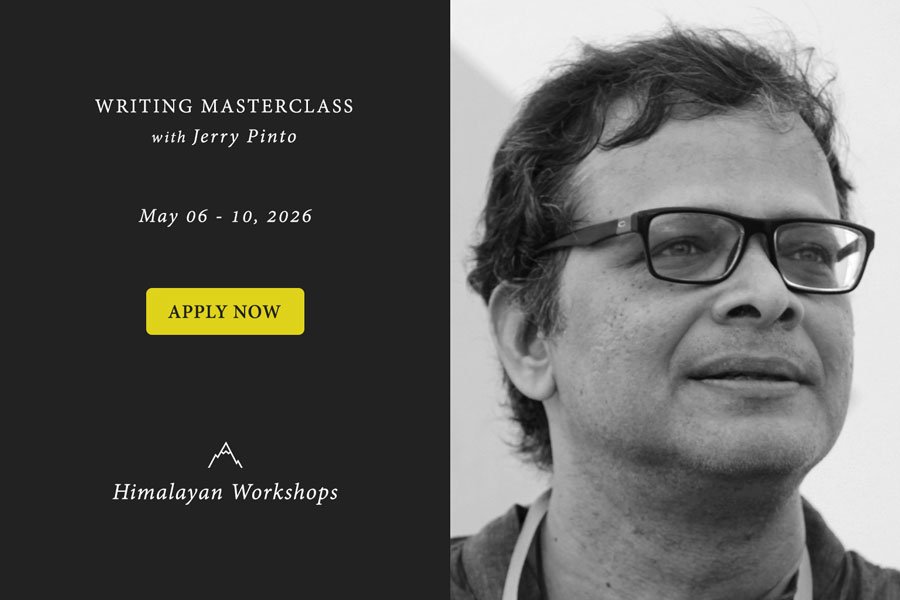
Jerry Pinto is a Mumbai-based Indian-English poet, novelist, short story writer, translator, as well as journalist. Pinto’s works include Helen: The Life and Times of an H-Bomb (2006), which won the Best Book on Cinema Award at the 54th National Film Awards, Surviving Women (2000) and Asylum and Other Poems (2003). His first novel Em and the Big Hoom was published in 2012. Jerry Pinto won the Windham-Campbell prize in 2016 for his fiction. He was awarded the Sahitya Akademi Award in 2016 for his novel Em and the Big Hoom.
Dear poet/writer, we’d love to know you better.
What are you writing?
In prose, you prefer…
To stay informed about articles related to poetry writing,
would you like to get emails from us?
We don’t spam and you can unsubscribe any time.
In prose, you prefer…
To stay informed about articles related to fiction writing,
would you like to get emails from us?
And we’re happy to throw in two free courses, too
We don’t spam and you can unsubscribe any time.
To stay informed about articles related to prose and poetry writing,
would you like to get emails from us?
And we’re happy to throw in two free courses, too
We don’t spam and you can unsubscribe any time.
To stay informed about articles related to non-fiction writing,
would you like to get emails from us?
And we’re happy to throw in two free courses, too
We don’t spam and you can unsubscribe any time.
Team HWR: We will be focusing on two of your books today, “The Education of Yuri”, which got published recently and “Em and the big Hoom”. I’m in love with “Em and the big Hoom”. What I remember most from the book are the letters. The love letters that the people write to each other are so beautiful. I was just wondering that did you make them up or was it like a Bridges of Madison County type of thing where you actually found a stash of letters that they wrote to each other?
Jerry Pinto: There were many letters that my mother wrote to my father, and very few that he had written to her. But I thought to invade their letters would not be fair. So, I invented the letters. I stayed within the bounds of what have been created by the letters that they sent to each other. The entire book is fiction because all those letters and the diary entries that happen at some points weren’t public yet. Maybe one day when I feel less vulnerable, I will put those out into the public sphere.
The challenge was to try and get in the skins of two very different persons and to say what they are saying. A friend of mine once told me about Keats’s negative capability comment on Shakespeare. I presume that every writer wants to try that out, to see whether they can inhabit the skin of another person who is not like them and to produce a being from that skin. Then to put a soul into that being to make them come alive, and then dress them into words and put them into a piece of paper again.
Team HWR: This brings up a related question, because I know that it’s very close to being a memoir, yet you’ve got it in the genre of fiction. Is that right? Why did you choose to categorize it as fiction when it is a memoir?
Jerry Pinto: It’s not a memoir so much as it is an account of a way that a life is lived. But there were two reasons, I think, to make it fiction.
One was that when it got difficult to write, I could always say to myself, Jerry, this is about the Mendeses. Just do your work and write about the Mendeses. This is not an account of your family. And the second, I think, is something to do with the fact that life does not yield easily to the processes and demands of fiction. Fiction requires you to do something very different. I think in some ways I felt that a cage had been created. Each reader who stepped, who starts reading “Em and the big Hoom” found themselves in that cage. At the end, the duty of the writer is to open the cage to the reader again. In real life it was my mother who lived for many years after my father had died. Those were not happy years and therefore in fiction, I reversed this and I let the character called Em die. I gave her a quiet, peaceful death in her bed. I let all the readers out of that door. I showed them the way in which, when a dominant character moves on, how everybody is kind of a little strangled, and unaware of how to deal with this new emptiness that is there.
Brush up your creative writing skills with our article about 17 Types of Creative Writing
Team HWR: Anything that you write that follows Em would be a tough act. It would be a challenge for the writer. Did you think much about that? Was there a lot of pressure on you or were you just on to the next thing?
Jerry Pinto: No because even before Em came out, I was already writing other things. I was working on many of the other things and fundamentally almost everything that I did had one aim at the base of it, which was my freedom. So, I gave up well-paying jobs, and the rat race. I wanted to stay at home and write so that I could get up in the morning and say to myself, “Jerry, what is it you want to do today?” And then get on and do that.
A lot of the things that I have chosen to do, or not to do, have cost me something. You see other people getting on in their careers, earning a lot of money and lots of good things happening to them. But my aim has always been that I should get up in the morning and determine the course of my day. For myself, that seemed like the most beautiful thing to aim at and I have never, not never regretted it. But 99% of the time I don’t regret any choices that I make. I am not going to allow a piece of my writing to also limit my freedom and my choices.
I had a friend who said that I shouldn’t write anything more after this. Just because that was the most magnificent book that he had read. He believed that I was never going to get better than that. I thought that was a compliment to EM, and an insight about me both, at the same time. It was both beautifully and efficiently delivered. That is what one expects from friends often.
I determined that if I felt like writing, I should try it. Expectations, what people think and how the reception of a new book is going to be is not my concern. It’s not going to be a concern. If it were to be my concern, then I would probably want to write bestsellers. There are the writers who are concerned with audience reception, how many copies sell, whether they are hitting the right marks at the right point in time, and whether they have the pulse point of the mark. I’m not denigrating that but these have not been my concerns. Many people have stumbled on ‘The Education of Yuri’ as the first book that they’ve read by Jerry Pinto. They have liked it, enjoyed it, and responded to it in various ways.
One young person wrote that it was exactly the story of her life. She’s 23 and just out of college. So, I am so relieved to see that The Education of Yuri has had a life that is involved in some ways with the Em and the big Hoom, because it’s by the same writer, but it is also independent. So that’s the best possible situation.
Team HWR: Talking about The Education of Yuri, I’m not born and raised in Bombay, but I’ve spent about five years in Bombay. I was there in the late 90s and a lot of the places that you talk about, which I know some of them don’t even exist anymore. There’s Crystal, Samovar, Strand, even Mahim, I’ve lived in Mahim also in a rental flat shared with poor people. I love how they seamlessly fit into the narrative without getting in the way. They don’t feel forced. They’re not pressured or put there. Did that just happen? Did you want all these places in the narrative? Because it helps the connection, I think, for somebody who knows the places.
Jerry Pinto: Yeah, a lot of it is unconscious planning in a way. I wanted to bring pods of memory in my mature readers, by reminding them of the 1980s. I worked very carefully about that and plotted the way I was going to work on the book.
There are things that ring a bell for you. They strike plunging chords somewhere. They are about memory. They are about desire. They are about loss. They are about the places where scenes of big intensity were staged and concealed. You are trying to love when you are trying to make war and we all are trying to grow. The struggle inevitably spills onto the place. It’s not a concealed or a thematic time of struggle. Every time I walked there many years after I finished my college, many strong memories came back of going there with people and without people. Someone walked out with rage from leaving a dish uneaten. You’re thinking that you have to eat it all because it will get wasted otherwise.
The kinds of things that young people did. Our generation lived very impoverished economic lives. It is not that we got pocket money on a regular basis or anything like that. You had to actually make your money. So, every ₹25 that you put down on something was ₹25 that you had earned. In making Yuri an economic agent, like giving him tuitions to go to, making him worry about how he’s going to live and manage his life, I thought I was evoking a time and a place when these things were not taken for granted. The young people these days often go to a Barista for a cup of coffee. And then of course they complain that books are expensive. If you are paying ₹180 for the cold coffee, you can get four books for that price. Those books will last you forever. You can go home and make yourself a cup of fairly decent coffee and sit and read them, but those are your priorities, not mine.
I don’t think that I planned a nostalgia snap of Bombay. But what I did want to do, was remind myself of a younger version of myself flailing in the avenues of the city.
Team HWR: I think that frame or lens is really interesting because you don’t seem to think of money which is really a factor. I have a lot of questions about Yuri, which I’m not going to ask because I don’t want to give out spoilers. In this group, there are lots of writers who are trying to say something deep or trying to convey a message and then there are writers who are just trying to tell a great story.
And we often discuss that amongst the writers. When you’re trying to write something, what’s driving it? Do you think of message and all of that stuff? Or do you just write what you want to tell?
Jerry Pinto: I think it is always with a message because I’ve been lucky. When I have a minute to write, I can write a column. I can say that this is my opinion. Those opinions will inform your writing prose or the poetry, or all the novels that you’re writing that will bring the entire buffet of the self. One can manage to bracket off a part of oneself and say that’s not what’s going to be like into this work. The rational and argumentative Jerry Pinto will turn up in the essays, in the opinion pieces for the newspapers. The subversive Jerry Pinto, who wants perhaps to share his story will turn up in the novels. I hope that those messages are so deeply buried that they don’t act as messages. I have the feeling that I am relying really on the goodwill of the readers and on the intensity and clarity of reading.
There is a terrible tendency now to talk about TBRs, about the number of books that one has read during the course of a year and to be almost out of that number. Therefore, this kind of reading may often mean that intensity of reading is lost because people want to read a large number of books. Thus, the two things that happen are: one is that people consciously choose shorter books, which is not bad. You can find some very beautiful short books. The second is that they read at an astonishing clip, just risking past pages. I often feel it’s very sad and almost insulting to a writer who may have spent two years working on a book if you choose not to give some quality time in reading the book.
I really rely on the reader to see the message. I have found there’s no way you can predict what message the reader is going to take away from the book. Every reader brings a fresh and delightful new perspective. I think it is a part of joy encountering readers at festivals or having them write to you on social media and tell you what your book is about. It means that they have possessed the book, they have taken it into themselves, and they have made it a part of themselves. In that sense, you then get a new book entirely. That is the wonder and the joy of reading. Yeah, I think that is why we all are in this business, because readers are different from us, and therefore each reading is a reinvention of a book.

Team HWR: My next question is about the tone in the two books. Em has a sense of foreboding through the entire book, it’s almost like you know that something not so happy is going to happen in the end. Yuri is full of angst and uncertainty of a young boy, and I felt it was overall brighter. One was dark and smoldering and the other was tentative and unsure even in the third person. Was that just the nature of the stories or a conscious intent?
Jerry Pinto: I don’t know, I could invent a story for you. Because that’s what we do as writers. We make stories. It is nice to invent a story rather than to say quite pathetically that you don’t know what you are doing while you are doing it. You are building this bridge and walking on it at the same time and you don’t know where this bridge is going.
On some days your characters are behaving so badly. They say the most ridiculous things. You don’t understand where your characters are coming from? They interact with each other in extremely difficult ways. Then at the end of it, there is a reader who comes in and tells you that there is a grim foreboding tag over Em. I suppose now that I think about it, if you have a mother who is trying to kill herself at fairly regular intervals, you become tense.
But at the same time, I hope there was some humor in the book. There were some happy moments even if we were grimly tense and foreboding. In fact, I think Yuri is in such a terrible state throughout most of the book because down to his underwear he is worried. He worries the poor lad. And in some ways, I think he doesn’t know it, but he’s a fairly privileged boy. He’s getting an education. He speaks English and he speaks it well. He has made a friend.
But I had no choice writing about Em. I had to put it down at some point. I don’t think I could have written any other stories if I hadn’t written that.
With Yuri, I really thought I was talking about loneliness, that it is an inflict. Some of us grow up in families where everybody is intelligent, vibrant and vital. But my family tends to be very Goan, very ordinary, and intent on talking about the levels of humidity in the air, the heat of May, the shortage of mangoes, the drips from the tiles. There are times when you’re listening to this conversation and you love these people but you’re just thinking, “God save me. Can I talk about philosophy to somebody?” Of course, you’re completely ill equipped to talk about philosophy with anyone when you’re fourteen because you don’t have a philosophy. You still long for someone with whom you can talk about abstractions. That is for Yuri’s faith that he’s striving, he’s struggling to go out and find himself, and I think in the process he stumbles on bits of himself. I think what all of us discover is that nobody discovers themselves. It’s just a lifelong thing. You keep on stumbling into bits of new corners and dark areas. You think is that who you really are. They are also moments of great brightness and hope.
Check out our interview with master translator, Arunava Sinha, who also leads a Translation Masterclass at HWR.
Team HWR: Nobody ever discovers themselves. I think that’s very true. You’re always stumbling from one thing to the next. I do want to say that I wish I had somebody like Theo Julio to take care of me. Such a beautiful character.
Jerry Pinto: Thank you so much. I think in a very strange way, both the Big Hoom and Theo Julio are the man I hope to grow up to be. If you are fifty-six years old and you have not become either of those men, you know how hopeless this endeavor is. It’s not going to happen.
Team HWR: How do you deal with vulnerability as a writer for any memoir or autobiography?
Jerry Pinto: You deal with it by weeping. I’m not being dismissive of the question. What I’m saying is that when you’re doing anything that is meaningful, you’re actually saying, “Look at my sores, look at my scabs. Look at my wounds. This is who I am. I’m so ordinary.”
It’s a lovely question. I’m actually struggling to answer it. And here I thought I had all the answers. I think what you should do when you are being vulnerable is keep on writing about it. When you feel literally ashamed of what you are saying and of what you’re telling people or if you’re cringing at what’s happening with your words, that may be a good place to be at. That’s as much as that. Because I think no one wants to be vulnerable. My belief is that India is in such an angry mood these days. Because we are deeply hurt and we fear things and instead of fearing these things and admitting to fear and to hurt, we want to use rage instead. And rage is not the way forward.
So, when you say to yourself that you are afraid then you are saying that you are weak. But when you say that you are angry, you are saying that you are strong and you feel more comfortable being angry than you feel being weak. So, for me, I try to watch myself and some watching inevitably throws up really horrible stuff, like things that you’re deeply uncomfortable with. That is the nature of watching. I’m so sorry this is a very bad answer, but if a better answer comes up at some point, I’ll try and get in touch. This is what I can think of right now.
Team HWR: Is it necessary to read a lot of books before you start writing?
Jerry Pinto: Why would you want to write if you don’t read? I thought the only reason you want to write at all is because you have been a reader for so long. You’ve seen all these books on your shelves and you want your name on the spine of a book. So of course, it’s necessary. Reading is like breathing for a writer. It’s beyond necessary. It’s fundamental. You should read hundreds of books. For every book you write, you should probably read 300-500 books. That’s a good ratio.
Wondering how to read 300-500 books? Check out our article about ‘How to make the habit of reading books.‘
Team HWR: Do you give your drafts to friends for feedback and to get different perspectives of how different people will perceive your books, or is it just Ravi?
Jerry Pinto: Oh, no. Before I inflicted on Ravi, there is a reader called Jerry Pinto who reads the book again. So, I give it like a month or two after the novel is finished. Then I look at the novel myself, and that, I believe, is something that we have to do as writers. We have to send out our book in the best possible shape to anybody else. If you think about editors, they read piles and piles of books. They have poisoned their love of reading by making it a profession. There’s just so much that passes their tables that at some point they must also feel a bit sick. I’m sure they probably do detox, go on vacations where they don’t read at all. And that must seem like such a delightful time. I know I want a vacation with piles of books to do. But they must be detoxing by not reading. So, you have to send your book in the best possible ways. For a novel, I send it out to a couple of friends, poetry to some other friends. But in general, I’m becoming less and less dependent on their feedback and more and more interested in what I think. I think, without knowing it, we all become gatekeepers for other people. Especially with poetry, I think if the poems don’t seem like the poems I would write, then I would get uncomfortable. I’m relying now very clearly on myself.
Team HWR: What is your writing routine and how do you deal with writer’s block? Does your inspiration for writing ever take a back seat and life takes off?
Jerry Pinto: I write every day. I try to write every day, which means that there is often a time when I get up and I go to my table and I look down at the paper and I look at the pen and I think, why did I do this to myself? Why am I doing this? But I write anyway. I’m blocked. I hate what I’m writing. I find the words terrible. They are labored. There’s everything wrong with them.
But I know that if I do not write at this moment, and if I do not keep on pushing through, at that point I see myself as an ice breaker with ice floors blocking me. And I need to keep pushing through those ice floors, powering my way through them and suddenly, without knowing it, I am out in clean, clear water again. The good thing about writing is that the bad stuff can then be cancelled out. It can be edited. You can tear up those pages, you can delete it from Microsoft or from whatever software you’re using and simply keep the good stuff behind. But if you don’t do the bad stuff, you won’t get to the good stuff. So, my solution for writer’s block is writing. It is not writing that comes with joy. It is not writing that you like doing. It is writing that you are doing to heal the writer’s block. You realize there’s something in your way and you try to push past that something because to you, writing is important. It is central. It is worthwhile doing. It is always going to be worthwhile doing, even when I don’t want to do it. And so, I become a very stern parent to myself. And I say, “Jerry, do your writing. As simple as that, Jerry. Just sit down and write.”Sometimes I’m a gentle parent. I say, “Jerry, ten lines only. Finish the end. Come to the end of this page and then you can go, please.” When I finish this thing, I say, “Let’s come up with one more page, and one more page.” Then I actually urge myself to write five-hundred words. In all the writing that I do, I write a few1000 words a day because there’s translation and editing to be done.
A lot of words will get done, but there’s a number of words that I set myself as a target every day and then I finish that. I kick back and I am my own boss again. I can be free to do anything I want, watch Netflix or go for a walk with friends. But the first thing to do always is write.
Team HWR: What is a good day of writing look like for you? What is the process?
Jerry Pinto: I think a good or an ideal day of writing is when I have done some work on the novel, and the ephemeral moment of writing a poem has actually become a few lines of a poem. I’ve done some translation. I’ve had a nap. I’ve gone to the gym, I’ve done my yoga, I’ve done some meditation and breathing practice. I’ve hung out with the person I love, and I’ve had a good meal. That’s as much as I ask from an ideal day. It’s a lot. So, I have to make do with good days. If one or two of these things happen, it’s a good day. But all of these things will be tried through the course of the day. I will try to do some of it.
I will try to write my novel, I will try to do some translation, try to hang out with the person I love, try to call or at least chat with a friend on the phone. You know all these things. If I can put four or five of these pieces of jigsaw on the table, I can see that design as a good thing. And some days I have to make do with two or three. Some days one shining moment will get me through the day. What can I say?
Team HWR: Does working on translations influence your approach when you’re writing your own story?
Jerry Pinto: Yes, indeed. I think I’m often asked this question about who is the Jerry Pinto? Is Jerry Pinto, the poet more important than Jerry Pinto, the translator and Jerry Pinto, the fiction writer?
I think there is one well from which the water is being drawn. Every time you go to the well with the bucket and you drop the bucket into the well, the well is changed as well. So, what do you draw from the well. I always feel that the bucket is intention. How have you gone to the well? Have you gone to the well asking to make you rich? Have you gone there asking to make you a better person or to give you the Nobel Prize. I’m not saying any of these is a wrong thing, but how you drop that intention bucket into the well will change the water in the well and will change you. There are no hermetically sealed compartments. The translation comes out of a certain vocabulary, poetry comes out of a certain mindset, and novels come out of a certain desire for self-expression. It’s all the same plasma state from which you’re drawing.
Need help with your writing or polishing your manuscript? Here’s a list of ‘Top Writing Coaches and Writing Mentors‘ for you
Team HWR: When you wrote the character of Em, how did you so effectively get into her head? Was this the product of research or observation or imagination?
Jerry Pinto: Yeah, I suppose I did research. Like, in the sense without thinking it was research. I used to do a lot of reading of psychological books and books about the mind and all because I was so frightened that something would happen to me. It wasn’t about trying to understand, very honestly, I have to say that it was actually about being frightened.
The research came out of my deep reading and engagement with mental health issues. They were really an outcome of my fear that I was going to go mad one day, otherwise it was based on all the things that I had experienced in my life. The difficult thing was what you left out because there was so much that could be put in so many wonderful moments. So many exciting conversations. It was about editing it down. I think the original draft was about 700,000 words and it came down to about 130,000. I generally overwrite with almost everything I write. For The Education of Yuri, I wrote about 500,000 words and then I cut them down.
I give myself liberty to write down everything that I want to. I know sometimes I’m going off on a tangent but then I get curious to know what this tangent has to do. It might have something to say. I just go there. I’m not a very disciplined writer in that sense. I’m disciplined because I try to write down everything. I’m not disciplined in the sense that I won’t get in the way of the words as they are. And then again, the discipline of editing kicks in and I’ll see where the story actually is and cut out all the things.
Team HWR: In an interview you said that you began writing at sixteen. And the version we’ve read now was completed more than twenty years later. You’ve talked about what changed. You let go of the idea of art as the Artic and writing the novel, going from one to the other. Still with your story that draws from your own experience, did anything in particular change in your process when you sat down to write?
Jerry Pinto: Everything changed and the central change was I changed, I grew up. The first few drafts were moans of despair. They were self-pitying. Oh, what a terrible life I have that my mother is mental and everyone should be sorry for me. That’s like the terrible stuff. I mean because that’s who you are. You are solipsistic, egoistic, a fourteen-year-old boy who thinks he’s going to write a novel and capture big sort of issues like psychology and philosophy and not even just elements of that, but all of it in his track because that’s who you are. And I don’t think people should be any other way. As a 14-year-old, you should have grand plans and as a 40-year-old you know that you can write a short novel about a decent story and when it goes out into the world and then the alchemy and magic of reading happens. It will become a bigger thing. But you have to rely on readers to make it a bigger thing. You’re not doing the big work. The readers do the heavy lifting.
Check out our interview with prestigious Sushila Devi Award Winner (2021) Anukriti Upadhyay.
Team HWR: How do you fictionalize real life? How do you put yourself out there while also escaping a damn eye? How to write authentically of other people and how to write off a life that is far from what you’re actually living?
Jerry Pinto: I think young people these days have headphones on most of the time, and headphones cut you off from the rest of the world. I understand that it’s a ploy for young women, for instance. It’s a way of keeping unwanted attention at bay. You don’t want to engage because you know so many times when you have engaged in good faith, you have been caught. Or you have been sort of invaded. But for me, listening to people and listening to conversations is central. And often you hear a bit of a story, not the whole of the story, just a line that flashes in your head. And it is a good thing that you don’t hear the rest of the story because then you are allowed to imagine it.
When you get the whole story, when someone tells you the whole story, you’re trapped in that story, you’re locked there. But if someone gets you just a line or two, it’s enough fodder to start another process. So, one of the things that I try to do is to take the everyday experiences and make that a part of the world of writing. Of course, there’s the experience of the self, right? There’s interior self which is also a very rich place to go as long as you can confront that with a measure of honesty and which is why I think journaling is a very important thing for everybody to do. I think we should all be writing some form of journal, but it shouldn’t be just an account of the day’s events. It should be much more a look at what is going on inside your head.
Team HWR: How do you get into the headspace of the character of the opposite gender? Any pointers on doing that with an appreciate degree of fidelity?
Jerry Pinto: The thing is, I really don’t think of gender as important. I think of the whole character as important. I think these days one has to be a little more careful because people are talking about cultural appropriation. Would I create a female character and talk through the female character? I did that already with Em, right? I suppose I had some rights to that because it was my mother. Now would I do it again? I’m not sure. I think if you look at the way that men and women and other genders interact with each other, you’ll find that there are certain patterns which you’re noticing. Because you’ve been trained to notice them by the number of romantic films we have seen, the number of comedies we have seen, the number of media we have consumed. So, it would be much, much richer to actually pay attention when a woman is talking if you’re a man and to shut your mouth and listen with care and attention, and to pay attention to other things. We keep talking about research but my entire contention or research is other people. That’s what research is. The only way we can do this because we are actually parasiting on them, we’re absorbing them, is to be deeply respectful of them for sharing with us. Respectful parasitism, I think, is the answer.
Team HWR: That’s going to be a new oxymoron. Which is the book that you loved in recent times that you wish you had written it?
Jerry Pinto: A book that I loved in recent times is Land, Guns, Cast, Woman by Gita Ramaswamy. I do not wish to have written that book because then I would have had to live that life. And it was a terrible life. A magnificently interesting but terrible life. I think every reader should read it because it is also told very quietly. The prose is not ornamental. It is not self-pitying, it is simply a cool narrative of what happened and I think to do that is really a very difficult task and Gita Ramaswamy has pulled it off magnificently.
Team HWR: How do you know a manuscript is ready and can be shared with the publisher, and that it doesn’t require any changes?
Jerry Pinto: I hate to say this now because it will sound like I’m being magical and philosophical and spiritual in the worst kind of sense. But the manuscript generally tells you when it’s right. There is a moment when you try to change something and something resists. That impulse as if it says it is done now. This is the point at which you know it’s done and you let it go, but you have to go back to edit it after that. Editing is a different process. It means that the manuscript is still not done, but it is there. It is like mixing your salad. You’ve got all your ingredients and now you mix it. I mean it is an important task. It may even be fundamental to the notion of salad making. How well you can mix the salad, how well you can edit yourself. Maybe fundamental to get even published. Suppose you’ve done the first five pages wrong and a reader reading them is going to call it rubbish and toss it away. Maybe from page six, your book is really revealing itself, right? So that editing process is really set.
Team HWR: Have you tried translating poetry to poetry or been through a similar experience? What makes a good poetry to poetry translation in your view?
Jerry Pinto: I think essentially you have to be a poet to do poetry translation. If you look at AK Ramanujan, he’s a poet and he did some poetry translation, which is fabulous. I’m from that school. I have done some poetry translation, which is In the End, To Swallow the Sun, The Vadkaris Marathi, A Bongs of the Marathi Women Poets from the 13th, 17th century. That’s a really long title of the book and maybe you could check it out and see what you think. I think it does help to be deeply respectful of the original and to be deeply respectful of poetry as well.
Are you itching to publish that short-story or poetry, but don’t know where to start? Take a look at our list of 40 litereray magazines to submit short-stories, non-fiction and poetry in India
Team HWR: When one writes poems which come from a very personal place and experiences, how to know that it is okay to put it out there for others to read?
Jerry Pinto: The first part of that is, are you comfortable putting them out there? Because almost everything that we write is terribly personal. Even when I wrote about Helen and Leela, it was personal. It just seemed that there was a curtain between me and the readers because technically speaking, I’m writing about Leela Naidu in Leela Naidu’s words. I’m suddenly inhabiting Leela. That’s a personal moment there. Likewise, writing about Helen, what are the choices that lead you to Helen? That’s a personal thing. When you’re writing personal poetry, you have to ask yourself if you are comfortable with people reading it. And if you are uncomfortable, that’s a very good reason to keep on.
Are you sure it is worth other people’s time? We never know. This is an answer that we can never know. But you have to be sure that if the poetry came from a good place, that it will find the right readers who will welcome it into their hearts.
Team HWR: Great. Thank you. Thank you for your time.
You can watch the conversation here: