



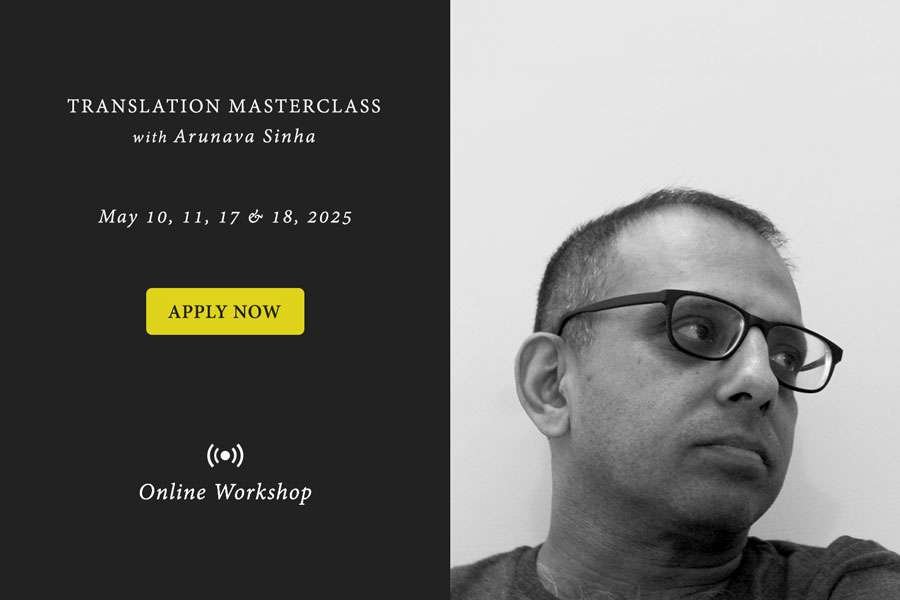
Arunava Sinha translates classic, modern, and contemporary Bengali fiction and nonfiction into English. Seventy-one of his translations have been published so far.
Dear poet/writer, we’d love to know you better.
What are you writing?
In prose, you prefer…
To stay informed about articles related to poetry writing,
would you like to get emails from us?
We don’t spam and you can unsubscribe any time.
In prose, you prefer…
To stay informed about articles related to fiction writing,
would you like to get emails from us?
And we’re happy to throw in two free courses, too
We don’t spam and you can unsubscribe any time.
To stay informed about articles related to prose and poetry writing,
would you like to get emails from us?
And we’re happy to throw in two free courses, too
We don’t spam and you can unsubscribe any time.
To stay informed about articles related to non-fiction writing,
would you like to get emails from us?
And we’re happy to throw in two free courses, too
We don’t spam and you can unsubscribe any time.
Twice the winner of the Crossword translation award, for Sankar’s Chowringhee (2007) and Anita Agnihotri’s Seventeen (2011), respectively, and the winner of the Muse India translation award (2013) for Buddhadeva Bose’s When The Time Is Right, he has also been shortlisted for The Independent Foreign Fiction prize (2009) for his translation of Chowringhee and for the Global Literature in Libraries Initiative Translated YA Book Prize for his translation of Md Zafar Iqbal’s Rasha, and longlisted for the Best Translated Book award, USA, 2018 for his translation of Bhaskar Chakravarti’s Things That Happen and Other Poems. In 2021, his translation of Taslima Nasrin’s Shameless was shortlisted for the National Translation Award in the USA. Besides India, his translations have been published in the UK and the US in English, and in several European and Asian countries through further translation. He is an associate professor of practice in the Creative Writing department at Ashoka University, and Co-Director, the Ashoka Centre of Translation.
Check out the details of the Translation Masterclass with Arunava Sinha HERE!
We interacted with him in FDC # 7 where he spoke about translated literature at large.
Team HWR: So, the first question is what pulled you into translation? How come translation now? what kind of led you to that path?
Arunava Sinha: It was when I was a student in college, and Gabriel Garcia Marquez’s 100 Years of Solitude had just come to our attention because he’d been given the Nobel Prize. And that book was suddenly available in Calcutta, where I grew up. It was in all the bookshops. So, for the first time, when I read a translated book, I actually realized that it was a translation, or I acknowledged the fact that it was a translation. Until then, of course, all of us in course of our studies and otherwise have read translated book, the great classics from Russia, the French classics, the German classics, and of course, the Indian classics outside of my mother tongue, which is Bangla. But for the first time, I consciously realized that it was a work of translation. And partly out of interest as a literature student, and partly, I think, responding to something that appealed to me innately. I started thinking about translation as a conscious process as distinct from the writing. Because here we were, going absolutely crazy about the prose of 100 Years of Solitude, including the famous first line, “Many years later, when Colonel Aureliano Buendía was to remember….”
But they were not Gabriel Garcia Marquez’s words. Those words were Gregory Rabassa’s, who translated them into English. And so, it was very exciting to realize that it was a mediation process that was actually establishing the work of art in our heads without it actually being the first version. So that led me to think about it. And then when you think about things like if you’re an amateur singer, you don’t just think about singing. You also try to hum tunes that you like. So, I tried my hand in college at passages here and there, and that got me interested. But it gathered momentum after I left college when we started a city magazine in Calcutta called Calcutta Skyline. And we used to run one short story, Bengali short story in translation in every issue, that was once a month. And so that was how I got down to the practice of it. And for the first few issues, I did the translation myself before others came forward. So that was how I got into it.
Team HWR: That’s a very interesting choice. So, your work spans very wide range. You’re, of course, working with contemporary writers, and then you’re also translating Sarat Chandra Chattopadhyay and Satyajit Ray. So, it’s also fiction to nonfiction because I saw that you’ve done the book on Mamta Banerjee. And then you’ve also, of course, read so much fiction. So how do you choose what you work on? And how much of this work just kind of lands at your door?
Arunava Sinha: Mostly, I choose or rather, I pitch so there are books I feel, that I’d love to translate, and I pitch them to suitable publishers. Not every publisher will be interested in every book, and if they accept them, which is mostly the case, then the books, that’s how the journey begins. But maybe one out of five or one out of six books will start with the publisher. As a matter of fact, the first translation of mine that was published, and there’s an interesting story behind this, which is that it was the novel Chowringhee, written by Sankar. It was him who asked me to translate it into English, back when we were publishing stories in translation in Calcutta skyline. So, in 1992, I translated that novel and gave him the English manuscript because back then, English language publishing was not big at all in India. He said it was for a French publisher, who was interested in publishing a French edition, but wanted to read an English version before deciding.
Fourteen years later, in 2006, an editor from Penguin called me and said, “We want to publish Chowringhee and the author told us there’s a translation. He didn’t remember the name of the translator, but he gave us the printout that you had left with him, and it has your name on it. So, are you the same person?”
It was a fantastic accident and perfectly timed because I was just about to embark on a midlife crisis. I was at that age, and so instead of the red Ferrari, I thought maybe this might be a smarter thing to do. That journey really began with the commissioned work because Sankar commissioned me to translate it, and then the editor in question wanted to publish. It wasn’t me making a pitch. I want to share this because I was thinking about this yesterday. I’m now currently translating a set of autobiographical essays by the same writer, Sankar. And in his essays, he talks about how he came from a very poor family, and he traces all the implausible things that led to him becoming a writer. And I was just thinking that had all these implausible things not happened, I might not have been a translator either. So sometimes the butterfly effect is really very strong, even if the outcome looks like it’s inevitable in some ways. But it’s still a matter of high probability that something does not start. The chances of it not starting are much higher than of it starting.
Team HWR: Oh, wow! So, interesting thing that you mentioned the red Ferrari, though. So, can translators afford red Ferraris?
Arunava Sinha: Can a translator afford a red Ferrari? No.
Any Color, for that matter, or even a car, for that matter, never mind a Ferrari, and certainly not in India. Unless you win an award or something. So, if you win the JCB award and I know the translator of the winning book gets ten lakh rupees, so three and a half lakhs are taken immediately off the top as tax. So, you’re still left with six and a half, which is enough to buy you a reasonable car if you so desire to use the money. I wouldn’t advise it though, because the money is not going to keep coming in very often. So, hang on to it.
Team HWR: Right. I also saw that in your range of writing. So, you mentioned fiction, we talked about Gun Island and there was the nonfiction book which is Mamta: Beyond 2021 by Jayanta Ghoshala. So, do you have a preference? And then I have a follow up question after that. But do you have a genre preference?
Arunava Sinha: Genre preference? No, I am led by the prose and by certain other factors as well. Such as, is it a voice that needs more representation, more of an audience? So, when I started out, like many other people, I started with the canon of Bengali literature. But after a few years I realized it was the equivalent of working on books written by dead white men. So, in a sense, while vernacular or a non-English language of India is kind of limited to its own geography. Maybe India has a wider geography, but it’s still limited to a geography. But within the language itself, there were very established writers with privileges and if not money, and certainly easy access to publishing channels. But later on, there have been a whole bunch of other writers who come from the marginalized sections, who do not have access to the publishing, who can’t get the books published by big publishers, for example. And which in turn means that their books don’t get distributed widely even within the state of West Bengal or across the border in Bangladesh. So, it was an interesting opportunity to enable a sort of leapfrogging of these writers, and even as they may not be in the mainstream of Bengali writing, to get them into English, translated literatures in English and very interestingly literature translated into English do two things. They occupy space within English literature in India. So, it doesn’t matter what language they come from. Once they’ve gone into English, they are now a part of books written in English, and then they become part of a space that is occupied also by those who are writing in English to begin with, which is a very different space in terms of the profile of the writers. For obvious reasons. I mean, in recent times I cannot think of anyone in the fiction space other than maybe Hansda Sowvendra Shekhar, who does not belong to the privileged sections of urban spaces and big cities and so on in some way. And that’s not their fault. That can’t be held against you. So, translations actually allow marginal writers to jump to national limelight. So, for example, two years ago, when Monoranjan Byapari’s There’s Gunpowder in the Air was shortlisted for the JCB Prize. Suddenly you had this situation where people all over the country were reading a book written by an illiterate Dalit writer who learned to write in jail by using a stick on dust, and who did and still almost does not know a word of English. And yet here he was being written and his book was being reviewed and he was being fated and honored and wined and dined all over.
So, translation, maybe this is not the question you asked, but the fact is that sometimes publishers don’t commission these works. They start on their own. They gather momentum of their own. A translator works like an agent in identifying books that might be worth bringing to the mainstream. But then, interestingly, right now, we are going through a phase when English language publishers are very keen on publishing the Dalit writing. So suddenly you have a very wonderful flow of translations of the Dalit writings from all the non-English language or any of the non-English languages of India flowing into the mainstream English press. That’s fantastic. Right?
And so, commissioning also has become not just a question of which is the best book or which are the best books to be read in translation, but also focusing on the writer themselves. So, the identity of the writers also become important. And I think that’s a good thing because reading and writing are both such political acts, especially now, that this is a very important factor that should be included in any decision making, especially since for every book you publish, there’ll be one book you don’t publish.
Team HWR: Yeah. No, for every book you publish, there’s probably 100 books you don’t publish.
Arunava Sinha: If I’m going to publish a book in November and I pick this one, then there’s some other book I could have published instead, which I won’t now. So, you’re right, it’s one of those hundreds or thousands, but at least one book misses the bus.
Team HWR: Interesting that we are talking about the politics behind the whole thing, because that was actually my next question. When you’re doing nonfiction work, or even in fiction, there is something that the writer is trying to say. And then when you come in and become the writer’s voice, you will bring in a nuance. You can bring in a different shade, change the flavor a little bit, potentially change the way that the story is being told. So, do you try and check your own bias or do you let your bias come into the writing? And how does that whole dynamic work?
Arunava Sinha: No, you are not there. You’re an instrument. You’re a musical instrument which is reproducing the notes. But you are certainly not there to insert yourself with your ideas or your ways of writing or any such thing, or your interpretation, for that matter. So, the text must shine through whatever the text is saying, whatever possibilities it holds, all the different ways in which it can be interpreted must all be interpretable the same way by the reader. So, no translator who’s worth their salt is ever going to try and do what you mentioned, consciously, of course. However, there are unconscious biases, and you have to guard against those as well. So, it’s very important to see what you’ve written to make sure that doesn’t happen. But usually, most translators are quite good at ensuring that this doesn’t happen. And it’s also a mode that gets stronger, the more you learn to write in an invisible way, the stronger you get at it and the more you do not try to do write in any other way when you’re translating. So that invisibility, as it were, always remains.
Now, many translators around the world say that, no, it’s not quite as simple as that.
Sometimes we do intervene in terms of craft, language, and vocabulary. Of course, you have to do that simply because no two languages are alike. You’re not going to find one to one correspondence. So, you’re certainly going to use your judgment of what words to use, what phrases to use, how to structure your sentence. The only point is, are you doing it to say, hey, I can make it better, or are you doing it to say, hey, this is how it best reflects what I read in that first version, in my case in Bangla. Most translators, most of the time will go for the second, which is, hey, does it reflect what I read? But some translators sometimes will feel that maybe there’s something they can do to bring out something that’s very hidden, needs to be foregrounded a little more. So, some translators will do that, and it’s a matter of personal choice and ethics, I would say. No right or wrong or good or bad about it.
Team HWR: Yeah, okay, cool. I would imagine that’s a very difficult space to try and maintain that neutrality.
Arunava Sinha: To be honest, it’s not. Sometimes, of course, for example, there was a novel I translated, a historical novel called By the Tungabhadra, by a very respected writer named Sharadindu Bandyopadhyay, who also wrote Byomkesh Bakshi, crime fiction. So, in his novel, there was a very strong anti-Muslim sentiment in some parts, although it said in historical, it said in the Vijayanagara kingdom of the 14th century. But it’s not just the characters who you can still understand if they have certain sentiment, but it’s also the narration itself. So, I kept it the way it was. I just added a little note at the end saying, these are the author’s views and not the translator’s. Or rather, this is not the author’s view, but this is the author’s chosen narratorial strategy. I don’t even know if it was his view. He had just chosen to say he wasn’t writing an essay, so it couldn’t be passed off as his view. It was a work of fiction. This was the line he took in his narratorial strategy. I do not endorse it, but as a translator, I’m duty bound to tell you what he said without making it seem better or smoother or softer in any way.
Team HWR: Okay, cool. But that translation loss, like, even if you look at Ret Samadhi and you look at Tomb of sand, if anybody, who knows the two languages, can tell you that there is a difference in the way those two titles sound. And I’m guessing that there is some part of any text which gets somehow, there is some nuance, some very final element which will land up not coming through. Is that reality? Is that how you see it is?
Arunava Sinha: It is certainly a reality but the way I frame it in my head and many translators do really is that every language has its own way of expressing what’s in it. Right? And so again, since two languages are not alike and certainly English and the non-English languages of India are not alike at all because they share very few common roots except the etymology of some words. Because of this, naturally even whatever you take from one language into another in either direction is going to be different. It’s not going to be identical. The point, however, is that reading a translated book at the end of the day is a little different from reading a book in a language that you know very well because chances are, it’s not essential, but chances are that a book in a language that you know, that’s your lived language whether it is Hindi, Tamil, Bangladesh, Kannada, French or Spanish. It is also likely to be from your own culture. So, you live in that culture. You’re deeply aware of it and a work in that language means a lot to you because it points back to many things in your life, in the life that you’ve lived and the life that you know of. Right?
I mean, when I read a Bangla book, there are immediately a thousand echoes that are going off, bells that are ringing in my head because there are so many things that it’s almost unconsciously referring to. Now, if this is going to be read by someone who is not from this culture, they are not expected to make those connections. But those of us who belong to that culture sometimes get terribly anxious and we say oh, but they will not understand. How will they ever get this? And my whole answer to it they’re not supposed to get it. You don’t have to battle it so much because think back for a moment when you’re reading Russian literature, Spanish literature or Japanese literature. Do you believe you are getting everything there? Of course not. You are reading the way an English-speaking person read that literature and has brought it to you. They are giving you what they read. But what I read is not what a person reading in that language is reading.
Now here’s an interesting point though, which is that, very often in the west, translators tend to translate into their mother tongue.
So, when they’re like, for example, Daisy Rockwell who’s translating from Hindi into English, is translating into her own language. So perhaps she is a little less attached to the Hindi and perhaps she’s able to see it more dispassionately and play with it more, because Ret Samadhi, which you’ve read, is very much a novel of sounds. It is very much a novel of Dhwani, the meaning of the words is less important than the sound of the words, almost like poetry in that sense. And you can see that the narration gives into the seduction of sounds. And so, there are a lot of digressions and so on simply because the narrator is playing with these things. Now, someone might say, but this word means X-Y-Z and here’s its origin and so on. And how will you ever get that in English? So, you can’t translate it. So, it’ll be lost in translation. But someone like Daisy, she’s less attached in that sense. So, she is more intent on saying, okay, how can I sing this song in my voice? Right? And she will sing it in her voice, and it’ll be her voice. She’ll follow the notes and the tune, but it’ll still be her voice, and so it should be.
So those of us, however, who translate from our mother tongues, like me and most other translators in India translate into English, are beset by this anxiety. Oh, God, there are all these things I know, and how will I ever get them into this other language? And then that phrase crops up. Lost. What is lost? What am I losing? But really, if you think of it without the translation, you’re losing everything. You’re not reading it at all. So, in the very first place, the translation itself is bringing you a very large part of the book that you have in the first language. And it was written. I would also argue that books that survive, books that last for long periods, for decades and centuries, are not imprisoned by their language because language also changes in that period, right? A Bangla in which a Tagore wrote or a Bankim Chandra wrote or even a Buddha Dev Boss wrote in 1940s is not the Bangla in which we are reading it now. And yet we consider these books great. So why is that? Because there’s something in them that is not bound only by the words and phrases in which they have been expressed, but something a higher realm on which they exist, which is something the theorist Walter Benjamin talked about.
And he talked about the fact that you take it out of its first set of clothes and dress it in a different set of clothes. You have a certain pure, non-linguistic version of the work, as it were. And when you start thinking of it that way, things become easier. Then you take it into a new language. So, you’re saying, Now I have an idea, and I’m trying to express this idea in this language, rather than saying, I’m trying to take this word or this phrase or this sentence into this language. So, I have an idea. I have a music; I have a silence and all of this. You do, however, not by abstracting or summarizing or anything. You’re still following it word by word and so on. But you are getting something that is in the words and also outside of them. And most of all, you are trying to make sure that what is outside of them goes into the new language. So, I would say if you were to stick to the lost in translation metaphor, then you are also gaining in translation because the book, in its translated version, in that other language, can do what that other language does, which maybe the language in which it was written cannot. So, in that sense, Tomb of sand does some things with English that Ret Samadhi could not have done in Hindi. And there is a very interesting point that Daisy makes in her translator’s note where she says that Ret Samadhi is a sort of accidentally Hindi version of this novel and Tomb of Sand is an accidentally English version of this novel. So, implying that the novel exists neither in English nor in Hindi, but somewhere else, and that you are projecting it and depending on whether you’re projecting it from a Mac or a PC, you’re getting slightly different projections on your screen. Right? And that’s all it is. And she points out that this is, for example, Ret Samadhi again is a family which is multilingual. It is set amongst a family whose members switch from one tongue to another, as we do in our lives, in our personal conversations. Right? In India, everyone is at least bi literate and many are tri-literate.
So, we move effortlessly between languages, which is something we now see reflected very well in the films and shows. However, a text somehow has this almost artificial need to be in one language, which is almost not a real reflection of the way things are. So, if we accept the fact, then that Hindi text or a Bengali text or a Tamil text or an English text for that matter, in certain contexts is only a choice. The language is only a choice. It is not the only vehicle or natural medium for the material of that novel, then everything changes. Right?
Team HWR: That’s a really interesting metaphor, though.
Arunava Sinha: I really think of translation as doing cover versions of songs where you’re playing the same tune, but at the same time, because it’s your voice, there is something you instinctively do or don’t do or can do or cannot do. And in this case, the voice is the language. So, there is something the language can do or cannot. And I’m very tempted to give an example from Tagore’s translation of Elliot from Bangla. But I fear it will not make much sense to most people because you really have to know Bangla for this. But I will try. Nevertheless. So, Elliott wrote, Journey of the Magi, which Tagore translated into Bangla, is relatively lesser known. Nobody knows that Tagore translated TS Elliott also, and he used, incidentally, an idiom and vocabulary that was not his at all. If you read that translation, you would never for a moment imagine that these are the words of Rabindranath Tagore. So, the poem, Elliott’s poem, ends with the lines, I should be glad of another death. And what Tagore does with it in Bangla is he says, arikbar mortapalay amibachi. Now, the thing is that if you take it very literally, it means if I could die once more, I would live again. So already at a pure level of word for word meaning, he’s taken it to a slightly higher level than, I should be glad of another death. But more interestingly, amibachi is an expression that we use in Bangla, not to literally mean that I’m going to live, but saved. It’s almost like on a very hot day, you walk into an air-conditioned room. So, it’s almost like, now I can live again because I’m back in an atmosphere that will sustain me rather than kill me, like a glass of chilled water on a hot summer day, or a hot cup of tea on a winter day. Now, this is something the Bengali language affords him, and he does it right. So that’s what I’m getting at. So sometimes the voice can also allow you certain things that will add more in a way, and you might even argue that that’s not okay. You’re suddenly infusing more meaning into it than even the poet did. But if you come to think of it, if you assume that the poet was thinking of something rather than using these words, this is what you think his thought was, and you found the best way to express it.
So, yeah, translation is a matter of continuous choice. And what matters really there is that you know that you are choosing and you’re asking the right questions. It’s not the answer that’s important, but asking the right question is important.
Team HWR: But you’re also still doing a lot of craft, right? I mean, it’s still a lot of language, and this is a great example, although I didn’t understand the Bengali entirely, but I think there is a very strong element of craft that is required. This conversation is great, and I have actually three more questions which are still pending, but we’re running short of time. So, I’ll ask you one last one, which I was wondering about. So, you translated what you call “the dead white men”, and then you are also translating people who are currently around and very much with us. Once a person is gone, then is it easier for you as a translator or how does that experience vary?
Arunava Sinha: Yeah, no, it varies to some extent. In some ways it’s easy. In some ways it’s harder. You can’t get clarifications if you need them on the other end. No one’s telling you that you’ve done a good job or a bad job. There is a famous apocryphal story about AK Ramanujam translating, U.R. Ananthamurthi, and Ananthamurthi read the translation and called up Ramanujam and said, “This particular line, you’ve got it wrong. This is not what I meant. What I meant was this.” And Ramanujam apparently told him, “No, what I’ve written is exactly what you meant. You just don’t know it.” But it’s a great story. Whether it’s true or not is immaterial. Sometimes you have to assume that, okay, this is what the writer meant. I have no way of asking them. So, I will just assume.
And in that situation, it’s easier to refer to a living person who will give you, their time. But it just so happens that in Bengali, writers are so very prolific that very often they’ve moved on from the novel that they wrote, which you’re translating, and they don’t even have such a close relationship with it anymore. So, it’s almost as hard to get clarifications even from living writers, unless it’s a work that they’re very close to and or remember very well. But other than that, no, it’s not a problem. And some of them do like reading the translations and they offer very minor feedback.
Although one writer, very famously, I loved his response when he met me for the first time after I translated two of his books, an octogenarian and a very respected Bengali writer. He said, “Yeah, I know you’ve translated my books. Of course, they can’t be as good as the original. I know that. So, it’s all right if you don’t expect them to live up to the original, then you won’t have any complaints about them either.”
Team HWR: Okay, interesting. Great. Well, fantastic.
Questions from the audience
Question: Amazed to hear about the voice of the language, but this is difficult terrain. Ashok Mithran’s works have been brilliantly reimagined, but with Perumal Murugan’s works, there has been dilution of the essence of fame. Songs of a Coward was an exception. Your comments on that?
Arunava Sinha: Yeah. Yes. Thanks for that observation. And yes, it’s possible. I mean, I wouldn’t know, having read only the translation and been really enjoyed them, but if you’re telling me that in the Tamil versions, the pain was even stronger and deeper. But this might be one of those cases where you feel the pain because you’ve read it in Tamil and you’ll never feel the pain the same way in another version of it. It’s like listening to the cover version after you’ve heard the original. So that’s also possible. But then you yourself say that Songs of a Coward was an exception. So maybe some translators do or some translations do pull it off. I would imagine that this is where you have to play with language a bit. Now, English, interestingly, is a low-key language. It is not a language that naturally is a home for the kind of effusiveness that you sometimes find in non-English Indian languages. So, you have to play with the English there to bring out that particular quality. If you’re saying that the pain is what needs to be foregrounded, then that’s what the translation needs to do.
So then definitely it will have fallen short in that respect. But it’s also very easy to make it very melodramatic in English. Sometimes when you’re translating from Indian language, it turns out quite horribly because then you take it into almost farcical level. So, you have to just know what pitch to hit and so that you get both the rasa as well as the other elements of the prose in your translated version.
Question: I’ve admired your journey since college. I want to understand how would one imagine introducing Indian languages in English works of fiction? Currently, this is what I’m struggling with. For example, currently what I’m writing, it has a little bit of Hindi and Tamil. There is a character which sings old Tamil children’s song. And it’s very language focused. I mean, there is a rhythm to it. You can keep the essence in English by telling the story, but the power is really in the word. So, I’m really struggling with that and Amitabh, of course, does it really, really brilliantly.
I have read many of his works and I follow Bengali music and cinema a lot, including Satyajit’s. And what I’ve realized is the way he brings in certain…. I remember this whole passage of coming and going. And I have discussed this with a couple of my friends. And the way he brings in that concept of coming and going in his novel. The whole Indian essence of aana hai ke jaana hai. Never say when you’re leaving the house. Instead say, “I’m coming.” He brought out that essence. I want to know, how do you for someone as amateur as me, how do you really achieve that?
Arunava Sinha: Yeah. So, when you’re not translating, you’re quite free. You’re free to write the way you want to, bring out what you want to. And I would say you just have to do it over and over again till you feel that the prose you’ve written is yielding to you, what you want it to yield. But I would say just be fearless and don’t worry too much about grammar and perfection of the English language because that is also now a dead white man. If you read, let’s say, the English novels from African countries or from Caribbean countries, you’ll find how beautifully the language is used. I would even say it’s a new language using the same words, the words you may still find in the English dictionary, but the language that they create is quite one of their own. And I would encourage you to try something like that, not in the hysterical way that Salman Rushdie did it, but in a way that is perhaps closer to the rhythm of the language in which you’re thinking, or maybe your characters are thinking, then it won’t matter. Don’t compare what you are writing to what’s been written in English.
Okay, I know this is a very convenient advice, but it can help to not feel obliged to be like anything or anyone and just go wild with your language. I mean, you can always tone it down afterwards.
Question: How do I become a translator in the Indian scenario? Where can I gain the skill set for the same while also generating money?
Arunava Sinha: There’s one very interesting and paying option now to getting into translation. And this is not to translate text, but to translate dialogue. See, all these OTT shows and films desperately need translators for dubbing and for subtitles in different languages. And they are paying gigs. And there are actually companies that hire young people to do this work. They train them and they hire them. So, you could try starting there because they will teach you how to translate dialogue. And that’s one of the toughest bits, actually, of translation, translating dialogue. So, you could start there, you could make some money alongside. But as I hope you were around at the beginning when we discussed the possibilities of owning Ferraris, and frankly, that’s never going to happen if you’re a translator. So, making a living from translation in India, at least, literary translation is impossible. If you translate technical documents or legal documents or if you become an interpreter, it’s a different story. That’s a profession. But you can certainly learn this way. The other way of learning is simply to translate and seek out senior translators, ask them for advice. Maybe they’ll spend half an hour with you going over your translated text and giving you some pointers and so on.
And all the people who translate regularly are very good with mentoring, either formally or informally. Because all of us want more translators, we want young people to continue and keep up the momentum. So, I don’t think you’ll have trouble if you reach out, they will always respond to you.
Question: Why is Bengali amongst the most translated Indian languages?
Arunava Sinha: Not anymore. If you actually look at the past few years, you’ll probably find that it’s not Bengali anymore. Any guesses which language it is?
Malayalam. That’s right. It’s Malayalam now. And Malayali literature is really so good. Contemporary Malayali literature is so fantastic. And they’re new writers who just spring onto our data screens through translation. It’s fantastic. A lot of it has to do with the very strong embedded reading culture. In Kerala, you have reading rooms everywhere, and the more people read, the better will be their writing. Right. But Bengali literature, for one reason, there was a very vast amount of it. And there’s another funny reason, which is that most of the editors or a majority of the editors and publishers initially in English publishing were Bengalis. So, when it came to translation, they tended to very quickly pick books from their own language because they already knew those books. Right. So, it was and I think many of the first translators were also working from Bengali. So, it was more a question of these coincidences than anything else.
Question: Though, it is great to see Indian publishing making efforts to recognize translators by putting their name on the cover and also including in the awards credits, prize money, what other ways do you think we could get more recognition for translators and translations?
Arunava Sinha: Well, I don’t think this can come artificially. It has to come from the organic process of more people reading, more translation. As simple as that. The more translated literature you read, the more you’re going to seek out the names of the authors and the translators, and they will become names even among the reading public and not just among publishers and editors and prize juries and literary agents. So, it’s as simple as that. I think in India, translators get a better deal than many other countries in the world. We get our names on covers. It’s not always the case. In the West, they’re now starting a movement. Jenny Croft, who translated the Nobel Prize winning Olga Tokarczuk, and they also won the International Booker a couple of years ago. She started this movement to get translators names onto the covers. So, you can imagine they’re way behind us. India has been doing this for years now. Also in India, many translators do get a share of the royalty. So that’s equally good. The only point is now if the readers acknowledge their work by reading more of them, then that’s it. That completes the circle.
Question: I’ve been translating articles from Hindi to English. It’s a huge task. And I have to speak to the writer how to handle words which don’t exist in the other language.
Arunava Sinha: You won’t always find a word-to-word equivalent, but translators read. I mean, writers need to read, I would say maybe 1000 books for each book they write. Translators probably need to read 5000. Just read hugely. Read both in the language from which you’re translating and into which you’re translating. And you’ll find words, expressions, phrases popping out at you, jumping out at you. If you don’t read almost maniacally, it’s not going to work. For example, I read and when I come across words and phrases that I don’t use in my translations, I actually note them down and make sure to use them later on. And also remember that there is zero shame in this. A dictionary between the two languages and thesaurus for the language into which you’re translating are your best friends. Please keep them with yourself all the time. Not online ones. Real physical books right at your elbow when you are translating.
Question: what is your advice to use colloquials in English prose for fiction? Is italicizing advisable or glossary?
Arunava Sinha: Yeah, I mean, it’s up to you. I don’t think there’s any hard and fast rule. Again, it’s a question of why you’re using it if you’re translating into English. And what do you translate from?
The point is you have to first figure out why you’re using them. Are you using them only for color, as in to somehow convey the fact that your characters are from a particular milieu or use a particular kind of language? And that their actual language is not English? Or is it that you’re using a term or a phrase that simply cannot be taken into another language altogether without elaborate explanations. So first, get your reason right. Secondly, things like italicizing. Again, it’s a choice. I would say there’s no need. You are lending the language word to the English language while you are writing your story. So, it’s fine. Just keep it as a borrowed word. There’s no need to specially draw attention to it by italicizing it anyway, the reader will know that it’s not a word they know, right? So that shouldn’t be a problem. But the main thing is, will it interrupt the flow of reading for someone who doesn’t know the language? That’s the key question. And do you want it to interrupt it? Sometimes you may actually write your stories in a way where you want the reader to pause, in which case it’s fine.
But if you don’t want them to pause, if you want them to just keep moving smoothly, then you have to figure out whether you need to use them or not. Equally, how important is the meaning? If the meaning is not so critical that the reader can keep reading without really losing anything, then maybe it’s fine. But if not understanding the meaning of the word actually alters or distorts the reading in any way, then you have to think about it again. Right? So, again, there is no one size fits all answer to this. You can apply it on a case-by-case basis and as again, read translations from Spanish and French and Korean and other cultures, non-Western cultures, and see what the translators are doing there. Because you are also, in a sense, translating, right? You’re translating speech and stuff from the local language into English, except there’s no written version that you’re translating from.
Question: How to understand adaptation, like translation and adaptation? Basically, the work that I’m doing, I have to translate from Hindi to English, but then make that English article something of my own where I don’t lose the essence of what the writer is saying, what the research they have done on the craft. If you can give me some advice on how to think of adaptation. I have to make it understandable and readable. So basically, the research work has been done in Hindi language, like going to the ground and getting those narratives and crafted.
Arunava Sinha: I would abandon that idea of adaptation and just translate. And a good translation is supposed to be as readable as the original. I’m trying to really have to change things around for that.